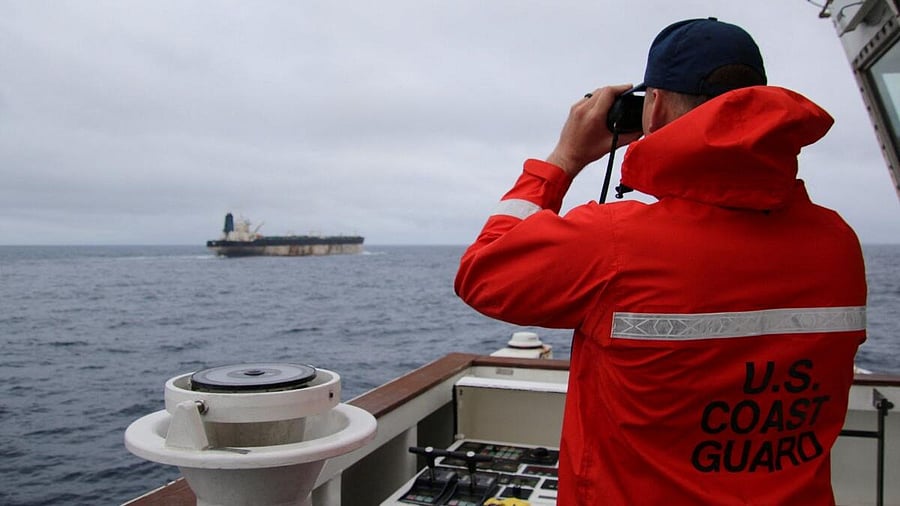
A U.S. Coast Guard official looks through binoculars at the ship Marinera (Ex-Bella 1) in this handout image released January 7, 2026.
Credit: Reuters Photo
The U.S. military intercepted a Russian-flagged oil tanker in the North Atlantic that had evaded a U.S. effort to crack down on Venezuela’s energy exports, U.S. officials said, sharply escalating a confrontation with Moscow after the ouster of its ally, President Nicolás Maduro of Venezuela.
The U.S. military issued a statement on the social platform X saying U.S. forces had “seized” the vessel for violating U.S. sanctions. The Coast Guard boarded the tanker after a roughly two-week pursuit, according to one U.S. official briefed on the operation. The Coast Guard encountered no resistance or hostility from the crew, the official said, speaking on the condition of anonymity to discuss a sensitive military operation.
Russian state-owned broadcaster RT published images of a helicopter approaching the Russian-flagged tanker being pursued by the Coast Guard and said it appeared U.S. forces were attempting to board. The New York Times was not able to determine when the images were captured.
The tanker — known until recently as the Bella 1 and now called the Marinera — has been registered as a Russian vessel, and Russia had sent at least one naval vessel to meet and escort it, according to a U.S. official briefed on the operation. There were no Russian vessels in the vicinity of the tanker when the Coast Guard boarded the ship, averting the possibility of a standoff between U.S. and Russian forces, two U.S. officials said.
Russia did not immediately comment on the U.S. operation. In a statement issued Tuesday to the state news agency Tass, Russia’s Foreign Ministry said the tanker was operating in full compliance with international maritime law, and said it was receiving increased attention from the U.S. and NATO militaries that was “disproportionate to its peaceful status.”
The tanker had been sailing in the Atlantic Ocean between Iceland and Britain with its location transponder active, according to ship-tracking data from MarineTraffic. Its destination was unclear, but from there, it could have been headed to the Baltic Sea or around Scandinavia to Murmansk, Russia’s ice-free Arctic port.
The Trump administration has put increasing pressure on Venezuela over its energy exports since U.S. forces captured Maduro on Saturday. On Tuesday night, President Donald Trump said Venezuela would begin sending oil to the United States, in what would be a significant concession by Venezuela’s new leaders.
The Venezuelan government has not commented on Trump’s announcement that 30 million to 50 million barrels of oil — about two months’ worth of production — would be transferred. If confirmed, the move would be the start of the president’s plan to exploit Venezuela’s vast oil reserves. Trump said he would control the profits “to benefit the people of Venezuela and the United States.”