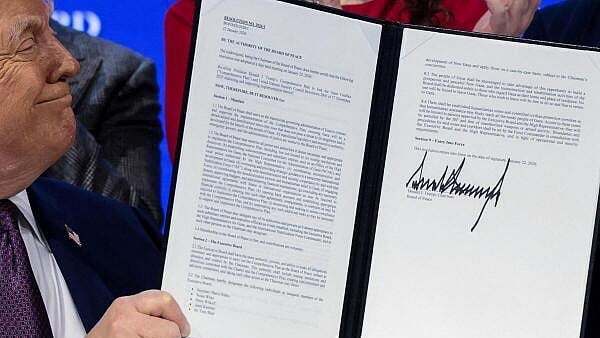
US President Donald Trump holds a signed resolution, as he attends a charter announcement for his Board of Peace initiative aimed at resolving global conflicts, alongside the 56th annual World Economic Forum (WEF), in Davos, Switzerland.
Credit: Reuters Photo
Davos: As the weather turned cloudy after four unusually sunny days in this Alpine resort town, the five-day annual meeting of the World Economic Forum ended on Friday with a caution against geopolitical conflicts, protectionism, mounting sovereign debt, misinformation, declining trust, risks from AI and economic gloom.
India offered a ray of hope, and its political and business leaders made a strong pitch for the world to do business in India and with India.
As many as 64 heads of state or government came here, with US President Donald Trump hogging the maximum limelight as he went on to deride almost everyone in his usual style. Leaders from other countries hit back, but mostly politely.
Trump, though, appeared to made some progress on his peace plans for Gaza and Ukraine. He met Ukrainian President Volodymyr Zelenskyy and said it was a "good meeting" and sent an emissary to meet Russian President Vladimir Putin with a message that the war must end.
On the Indian front, as many as ten states showcased themselves for investments and went on to announce investment commitments of crores of rupees, though some restrained themselves from announcing any numbers amid questions over the conversion of such MoUs into reality and criticism of even Indian companies signing such agreements in a foreign land.
On condition of anonymity, some business and government leaders actually said these numbers tend to be inflated to grab headlines and justify the huge expenses incurred by large state delegations.
On the positive side, the Indian growth story remained strong with several foreign leaders exuding confidence in India and business prospects there.
Indian leaders associated with the ruling NDA alliance unanimously credited it to Prime Minister Narendra Modi's strong leadership and economic policy, while others said it was the inherent strength of the country and its economy.
The organiser, the World Economic Forum (WEF), said the meeting set against the most complex geopolitical backdrop in decades served as an essential and leading platform for convening decision-makers for consequential dialogue that enabled progress on the most challenging issues facing the world today.
It was attended by close to 3,000 leaders from across regions, sectors and generations from 130 countries, including a record 400 top political leaders, a majority of G7 leaders, close to 830 of the world's top CEOs and chairs, and almost 80 leading unicorns and technology pioneers.
They exchanged insights on peace, security, technology, growth, investing in people and building prosperity within planetary boundaries.
"This is a moment of uncertainty, but also possibility; not a moment to retreat, but a moment to engage," WEF President and CEO Borge Brende said at the closing session.
"The World Economic Forum is not about responding to current events. It is about creating the right conditions that enable us to move forward," he said.
"We believe economic progress should be shared. We believe prosperity should reach further than it has, and we believe institutions like the World Economic Forum still matter in making that happen," WEF's Interim Co-Chair and BlackRock CEO Larry Fink said.
"This year, Davos has reached a new level. Not only was it the intended platform for dialogue, but it also marked turning points and drove decisions," WEF's Interim Co-Chair and Roche Holding Vice Chairman Andre Hoffmann said.
The fundamental importance of trust in preserving and deepening cooperation was a consistent theme throughout the week's conversations.
Leaders warned of the dangers of declining trust, both in institutions and in global politics, saying it erodes the ability to respond to shared challenges, from inequality and conflict to the climate crisis.
Participants highlighted that, despite some challenging headwinds, fresh bright spots of regional cooperation continue to emerge. Trade deals with India were referred to by several leaders, including the EU and Germany.
On the US-India trade deal, Trump said Modi is his friend, and they will have a "good deal".
WEF Managing Director Mirek Dusek said geoeconomics is the new geopolitics, and in this new era, we need much more dialogue, imagination and entrepreneurship to regain forward momentum.
"We are knocking on the door of these incredible capabilities. I think in the next few years we are going to be dealing with how we keep these systems under control, that are highly autonomous and smarter than any human," Anthropic CEO Dario Amodei said.
Tech leaders said AI agents are soon going to outnumber human beings, but asserted that humans and human intelligence will remain important.
The Forum's latest Chief Economists' Outlook expected global economic conditions to weaken this year but saw India anchoring South Asia as the brightest growth spot despite mounting trade headwinds.
On AI, IMF chief Kristalina Georgieva said, "It is a tsunami hitting the labour market and, even in the best prepared countries, I don't think we are prepared enough".
The WEF said it will also host a series of regional events to foster dialogue, trust and multi-stakeholder collaboration.
Over the next 18 months, the Forum will host new events with the governments of Turkiye, Egypt and Panama, among others.
The Global Collaboration and Growth Meeting will be held in Jeddah, Saudi Arabia, in April this year, and it also announced a high-level event in spring 2027 in collaboration with the Government of South Africa.