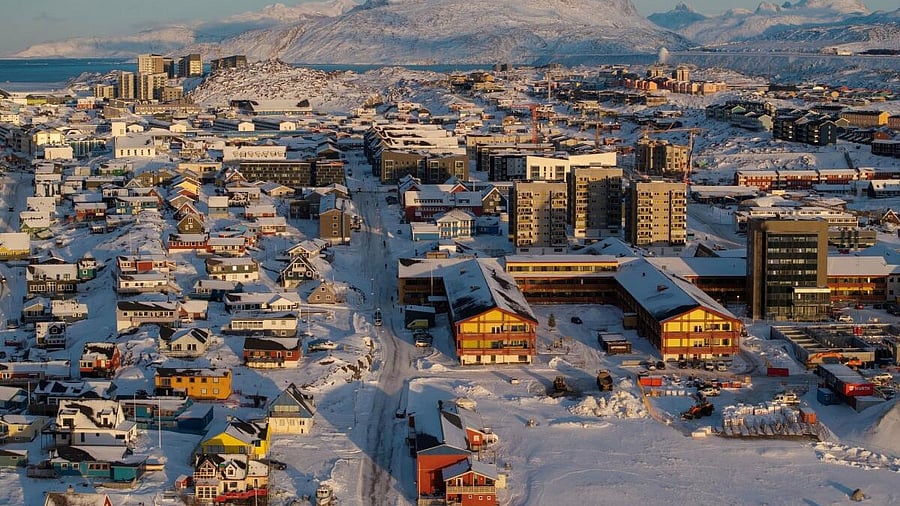
A drone view shows a general view of Nuuk, Greenland.
Credit: Reuters Photo
Washington: The tensions touched off by President Donald Trump’s demand for US ownership of Greenland deepened Thursday after Denmark and the White House contradicted each other in public about what the two sides had agreed on in a meeting hosted by Vice President JD Vance the day before.
Karoline Leavitt, the White House press secretary, told reporters that a delegation from Denmark and Greenland had agreed “to continue to have technical talks on the acquisition of Greenland.” Denmark’s foreign minister, Lars Lokke Rasmussen, said the agreement at Wednesday’s meeting had in fact been “to launch a high-level working group to explore if a common way forward can be found to address the American security concerns in relation to Greenland.”
US ownership of Greenland remained a red line for Denmark, Rasmussen said in an interview earlier Thursday with The New York Times. He added in a written statement after Leavitt’s remarks that if the United States does not respect Denmark’s territorial integrity and the self-determination of the Greenlandic people, the working-group process “will not be successful and will probably be short-lived.”
The back-and-forth underscored that Trump’s desire to take over Greenland, the huge North Atlantic island that is part of the Kingdom of Denmark, remained a flashpoint even after an intense push by Danish and European officials to defuse the potential crisis. Several European countries joined Denmark in deploying small numbers of troops to the island this week as part of what they described as a military exercise, and President Emmanuel Macron of France said Paris would be sending more “land, air and maritime assets” in the coming days.
Denmark’s small military buildup, which Danish officials say is part of a broader effort to tighten the defenses of Greenland, began to reveal itself Thursday.
Small groups of Danish soldiers dressed in green camouflage and wearing dark woolen hats walked through downtown Nuuk, Greenland’s capital. A few passersby turned their heads to look. Beyond Nuuk’s harbor, a 200-foot-long Danish warship capable of breaking through ice cut through the waves.
Trump and his top aides have not ruled out using force to seize Greenland from Denmark, a step that even some Republicans in Congress say would represent a catastrophic breach in US alliances.
Trump says the United States needs to take over Greenland because of the security threat in the Arctic posed by Russia and China, and because it would be “vital” for the “Golden Dome” missile shield he wants to build. Denmark, other NATO allies and most security experts argue that given existing treaties and Denmark’s status as one of the United States’ closest partners, Washington already has all the access it needs.
The “existing framework” between the United States and Denmark “could accommodate any American need for a stronger footprint,” Rasmussen told the Times.
He said that Denmark and other NATO members agreed with the United States that a heightened military presence was necessary in Greenland, but he insisted that the island did not face an imminent threat from either Russia or China.
Rasmussen said Vance and Secretary of State Marco Rubio had stressed potential future threats from China in the meeting Wednesday. He said the two officials had asked whether Denmark had the resources to ward off any such possible threat.
“If you zoom in on Greenland, it’s basically about whether there would be any increasing Chinese influence in a midterm, long-term perspective,” Rasmussen said, adding that the influence could be economic or a form of “soft power.”
Rasmussen said the United States would “hopefully” be part of an expanded, allied military presence in Greenland, “because this should be within NATO.” He compared the military buildup to NATO’s increased presence on its eastern border with Russia.
“The vision is that we could establish some kind of permanent presence,” he said, “mirrored in what we are doing at the Eastern Flank.”
Sen. Chris Coons, D-Del., who met with the Danish and Greenlandic delegation in Washington on Thursday, said in an interview that any forceful move on Greenland would be a “strategic disaster” with far-reaching consequences for the NATO alliance and global stability. He also said that both scenarios the White House had raised — either taking Greenland by force or buying it from Denmark — would require congressional approval and that “no senators want to do this.”
Sen. Mitch McConnell, R-Ky., the former majority leader, said in a floor speech Wednesday that moving ahead with a seizure of Greenland would mean “incinerating the hard-won trust of loyal allies.” On Thursday, the chair of the Senate Foreign Relations Committee, Sen. Jim Risch, R-Idaho, issued a more measured statement supporting negotiations on Greenland but stopping short of endorsing a takeover.
“Allied nations must all work together to protect the alliance and the High North,” Risch said after meeting with Rasmussen and Vivian Motzfeldt, the Greenlandic foreign minister. “I’m pleased that both sides have agreed to continue regular meetings at a high level and explore all options to get to a resolution of the issues.”
Rasmussen told the Times that one of his goals in Wednesday’s meeting at the White House complex, which also included Motzfeldt along with Vance and Rubio, had been “to ensure that this is a fact-based dialogue.” He said that he and Rubio had agreed not to discuss Greenland in meetings early in the second Trump term last year, but recent tensions had compelled him to open direct talks on the issue with top Trump aides.
It quickly emerged that Rasmussen and the White House disagreed on the basic facts of what had been discussed. While Rasmussen said the meeting had concluded with an agreement to hold further talks that respected Denmark’s red lines, Leavitt presented things differently at her press briefing Thursday. She said the “technical talks on the acquisition of Greenland” would take place “every two to three weeks.”
“The president has made his priority quite clear,” Leavitt said. “He wants the United States to acquire Greenland.”
Aaja Chemnitz, a Greenlandic politician and a member of the Danish parliament, called Thursday’s statements from the White House “tone-deaf.” She criticized the US for presenting a shared agreement differently than discussed, saying it was regrettable that “you can’t rely on an ally you’ve met with and reached agreements with, only for them to frame the issue in another way.”
Motzfeldt broke down during an interview with Greenland’s public broadcaster after the meeting Wednesday.
“I am overwhelmed,” she said, pausing to contain her emotions. “The last days have been tough.”