
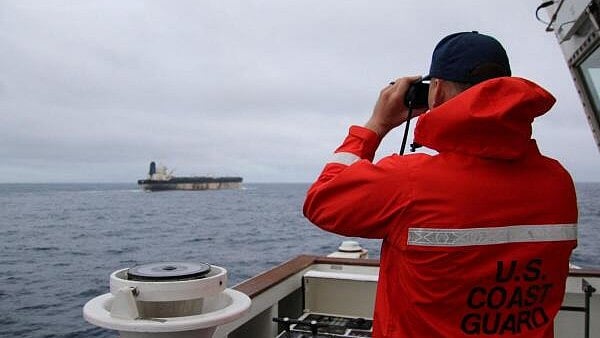
US Coast Guard member observing the tanker.
Credit: Reuters Photo
The United States on Wednesday seized a Russian-flagged oil tanker, Marinera, after a two-week pursuit. The vessel was formerly called Bella 1.
The ship was trying to escape US sanctions targetted at oil shipments linked to Venezuela, Iran and Russia.
The US military said the US Coast Guard seized the vessel for violating US sanctions by boarding the tanker following a dramatic chase that lasted for about two weeks. The move came even as Russia sent a naval vessel to escort it.
Reports suggest that this is the first time in several years that the US has seized a Russian-flagged ship.
The vessel started its voyage in Iran and left the Gulf of Oman in November. It travelled through the Suez Canal and Strait of Gibraltar before crossing the Atlantic in early December.
According to reports, the vessel was headed to Venezuela to collect oil when the US was enforcing strict sanctions on Venezuelan energy exports.
What happened in the Caribbean?
The US Coast Guard stopped the tanker in the Caribbean Sea on December 21. At the time, the vessel was still named Bella 1.
Authorities had at the time said they had a seizure warrant because the ship was not sporting a valid national flag.
However, the crew did not allow the Coast Guard on board and the vessel escaped into the Atlantic. The US forces continued to track it.
Identity changed as flag is painted
The crew acted upon the immediate threat to shield itself from the US. They painted a Russian flag onto the hull, as international law treats ships as being under the protection of the country whose flag they sail.
The ship also changed its identity from Bella 1 to Marinera. It was also added to Russia's official shipping registry, with Sochi on the Black Sea listed as its home port.
However, the effort failed as US officials said the ship was not under a valid national flag when first confronted.
Pressure from Russia
Russia also made a formal diplomatic request asking the US to stop the pursuit.
The request was made to the US State Department late on New Year's Eve, according to a New York Times report.
However, the US continued the chase and authorities maintained that the tanker was accused of violating sanctions and transporting Iranian oil.
The vessel suddenly changed its route as US increased its pressure on Venezuela. It started to head back towards Europe after stopping for a brief moment near the Caribbean on December 15.
This was the time when US President Donald Trump announced a "complete blockade" of Venezuelan oil tankers.
According to a Wall Street Journal report, the Russian navy deployed a submarine to protect and escort the tanker.
In the lead-up to the spectacular operation, several Western surveillance flights were seen over the vessel for about 24 hours.
These included aircraft from US bases in Iceland and RAF Rivet Joint and P-8 Poseidon planes from the UK, capable of detecting submarines.
The seizure
After the long chase, the US Coast Guard finally boarded and seized the ship in the North Atlantic on Wednesday.
The US military confirmed the success of the operation on X, saying the tanker had been taken for breaching sanctions.
US Defence Secretary Pete Hegseth wrote, "The blockade of sanctioned and illicit Venezuelan oil remains in FULL EFFECT - anywhere in the world."
Meanwhile, Russian Ministry of Transport said that in accordance with the 1982 UN Convention on the Law of the Sea, “no state has the right to use force against vessels duly registered in the jurisdictions of other states.”
Why is the ship important?
The vessel is believed to be a part of the "shadow fleet" or "ghost fleet" used to transport oil to Russia, Iran and Venezuela.
The vessel was sanctioned way back in 2024 over allegations that it carried illicit cargo for a Hezbollah-owned company.
The owner is a Turkey-based company, Louis Marine Shipholding Enterprises SA, which is accused of having links to Iran's Islamic Revolutionary Guards Corps.
Even though reports suggest that the ship was empty at the time of seizure, Russia's bid to send naval protection has raised suspicion as to why Moscow was willing to risk a standoff with the United States at a time when ties between the two nations are strained.