
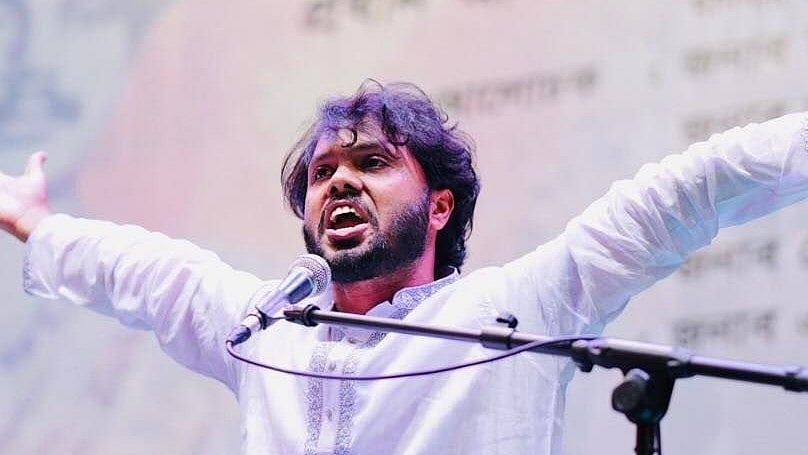
Sharif Osman Hadi
Credit: Facebook/@Osman Hadi - ওসমান হাদি
Bangladesh is teetering on the brink once again after Sharif Osman Hadi, a prominent leader of the July Uprising who was shot last week, died while undergoing treatment at a Singapore hospital.
Hadi was shot in the head by masked gunmen last week as he initiated his election campaign at central Dhaka’s Bijoynagar area.
While addressing the nation, Chief Adviser Yunus announced Hadi's death and promised swift action to catch his killers.
"Today, I came before you with very heartbreaking news. Sharif Osman Hadi, the fearless frontline fighter of the July Uprising and spokesperson of the Inqilab Mancha, is no more among us," Yunus said.
On Monday the government had sent Hadi to Singapore in an air ambulance for advanced treatment as doctors in Dhaka described his condition 'extremely critical'.
Following his death videos show mobs vandalising the offices of the country’s largest daily newspaper, Prothom Alo, as well as the Daily Star.
The demonstrations were marked by emotionally charged slogans invoking Hadi’s name, with protesters vowing to continue their movement and demanding swift justice and accountability for the attack that claimed his life.
Who was Sharif Osman Hadi?
Hailing from Nalchity, Jhalakathi, a district in southern Bangladesh, Hadi was born to a father who was a madrasa teacher.
He began his education at Nesarabad Kamil Madrasa and later went on to enroll in the Dhaka University where he studied Political Science.
He was most recently working as a lecturer at the private University of Scholars.
Hadi was founder of a 'socio-cultural platform' called Inquilab Mancha, which rose to prominence following the July revolution 2024.
A vocal critic of both the Hasina government as well as India, Hadi was instrumental in the rise of Inquilab Mancha as a politically influential group which demanded the disbandment of Sheikh Hasina’s Awami League.
After Bangladesh's International Crimes Tribunal (ICT) awarded Hasina a death sentence for 'crimes against humanity' Hadi hailed this judgement by saying, “This verdict has set a precedent for the entire world.”
A fiery leader, Hadi never shied away from his voicing his criticism for the Bangladesh Army as well as the Yunus-led interim government. He criticised the new government for not bringing about any significant change in the country.
Hadi's demise led to rise in the anti-India sentiment in Bangladesh, with many alleging Hadi’s assailants fled to India after committing the murder. They called upon the interim government to close the Indian high commission until they were returned.
National Citizen Party (NCP), a large offshoot of Students against Discrimination (SAD) that led last year’s violent protest, joined a student group, called Jatiya Chhatra Shakti and brought out a mourning procession on the Dhaka University campus and marched to Shahbagh.
“The interim government, until India returns assassins of Hadi Bhai, the Indian High Commission to Bangladesh will remain closed. Now or Never. We are in a war!,” said Sarjis Alm, a key leader of NCP.