
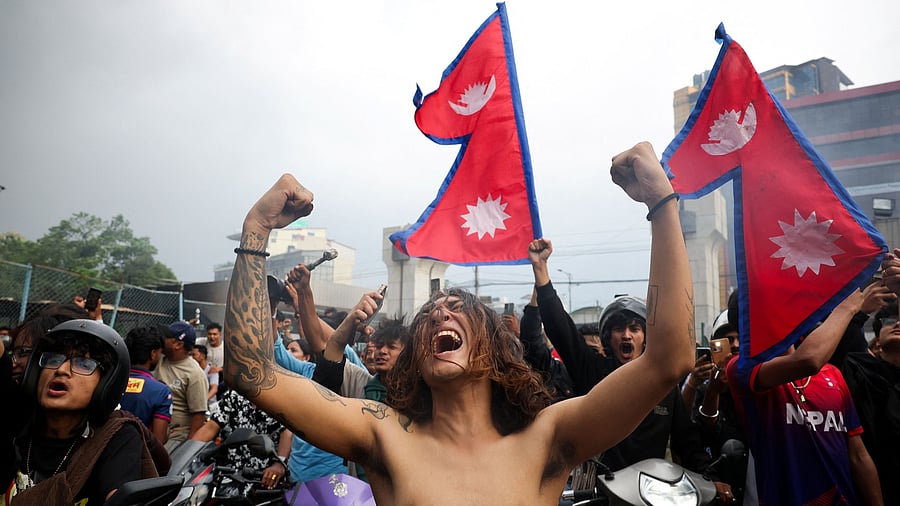
Demonstrators celebrate at the Parliament complex during a protest against Monday's killing of 19 people after anti-corruption protests that were triggered by a social media ban, which was later lifted, during a curfew in Kathmandu, Nepal, September 9, 2025.
Credit: Reuters photo
From Africa to Europe and Southeast Asia to Latin America, 2025 was a year which witnessed the people take out their anger against the state establishments on the streets.
While the geography varied, the reasons were more or less the same in most places - corruption, rising economic stress and fears that governments were becoming less democratic.
Corruption: A major trigger
One of the most significant uprisings this year was Nepal’s Gen-Z protests in September, which drew global attention. What began as anger over nepotism and corruption soon turned into a wider challenge to the political system, which eventually led to the resignation of Prime Minister K P Sharma Oli. However, the protests also led to the deaths of over 60 people, including a 12-year-old and several students.
Back home in India, the region of Ladakh witnessed a phase of turmoil in September, after protests erupted demanding greater autonomy for the region. The protests turned violent, resulting in the death of four civilians and leaving several injured. It also led to the arrest of Sonam Wangchuk, a prominent scientist and activist, who has been at the face of the protests. Internet services were cut in the valley and a curfew was also imposed in the region.
Students protest in Leh, Ladakh over statehood demand
Credit: PTI Photo
In the very same month, workers of France - teachers, train drivers, pharmacists and hospital staff went on strike and teenagers blocked their high schools, to protest against looming budget cuts. Unions demanded for more spending on public services, higher taxes on the wealthy, and for the reversal of an unpopular change making people work longer to get a pension.
In November, North Macedonia saw mass demonstrations after allegations of bribery and negligence surfaced following a deadly nightclub fire, which resulted in the deaths of around 63 people. Investigations had found that the nightclub was functioning illegally, with an invalid licence which it obtained from the government in exchange of bribes.
In Spain, tens of thousands took to the streets to protest against Prime Minister Pedro Sanchez’s government over political and corruption controversies. The protests were triggered after leaked audio recordings in which a member of the socialist party could be heard making defamatory comments against the police unit which were investigating the graft allegations against Sanchez’s wife. As per reports, over 1 lakh people attended the protests under the banner “Mafia or Democracy”
French gendarmes face with protesters during clashes at a demonstration in Paris as part of a day of nationwide strikes and protests against the government and cuts in the next budget, with supporters of the "Bloquons Tout" (Let's Block Everything) movement, France, September 18, 2025.
Credit: Reuters photo
In the Gambia, protesters demanded accountability from leaders they accused of long-standing corruption.
In Indonesia and Morocco, Gen-Z protesters questioned political privilege, poor public services and wasteful government spending.
Fear of weakening democracy
Protests erupted in Mali, the Central African Republic and Togo over moves to extend leaders’ time in power. Elsewhere, controversial laws became flashpoints — from Indonesia’s military law changes to concerns in Ukraine over weakening anti-corruption bodies and in Brazil over laws seen as protecting politicians. In the US, repeated protests targeted what critics called authoritarian actions by President Donald Trump.
Economic hardship was another big reason. Austerity measures also sparked protests in Belgium, Argentina and Romania. High prices pushed people to demonstrate in Greece, Chile, Angola and Ecuador. In Spain, soaring rents and lack of affordable housing led to massive street protests.
A common link in all these protests were that most of it were spearheaded by youngsters, particularly from the Gen-Z community. The rise of youth-led protests led to talk of a global Gen-Z movement. While young people were clearly at the forefront in many countries, this was not entirely new. What 2025 showed clearly was that people across the world were willing to take to the streets when they felt unheard, a warning sign that governments can no longer ignore.