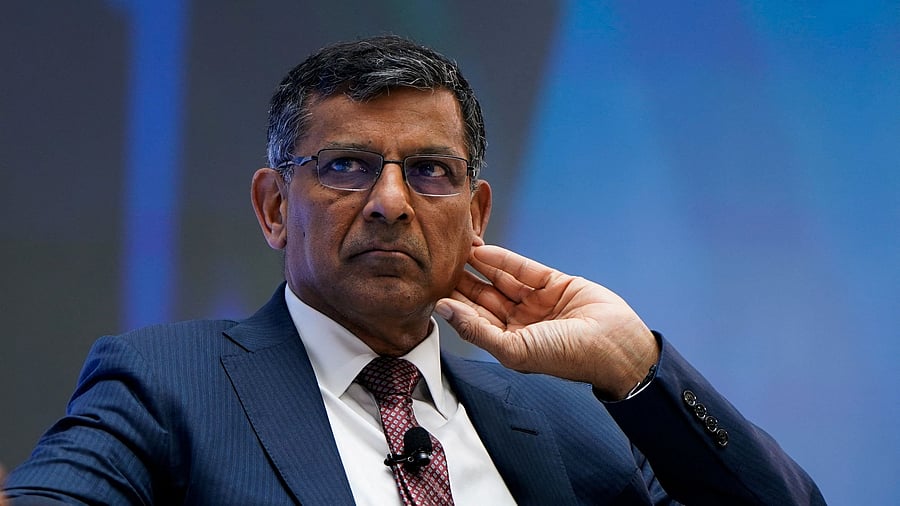
Former Reserve Bank of India governor Raghuram Rajan
Credit: Reuters Photo
New Delhi: Former RBI Governor Raghuram Rajan has said that unless India's domestic private investment increases, the country will not be able to attract foreign direct investment to the desired extent.
Rajan further said India has not seen a sustained increase in private investment by the corporate sector.
When asked whether he thinks it is very odd for capital to be fleeing from a country where economic growth at 7.4 per cent (FY26) is much greater than anywhere in the world, he said: "Well, FDI would come in if your private sector were also investing, but your private sector is not investing." "So, there is something we are missing here, and it may be, you know, some people have argued it is policy uncertainty," he added.
Rajan further said those issues are fixable and that the government is interested in economic reforms to achieve stronger growth.
"Because once we fix domestic investment, investment by our own corporations, we can fix foreign direct investment," he argued.
Rajan pointed out that some states, such as Tamil Nadu, are attracting foreign direct investment and emphasised the need to ask why foreign capital is flowing out of India.
"The second reason, I think, is this uncertainty of the US-India relationship, if this overhang of 50 per cent tariffs gets taken off, we will really be able to take part in more global supply chains, and that would be very, very useful for India," Rajan said.
India's net foreign direct investment (FDI) remained negative for the fourth consecutive month in November 2025, with outflows exceeding inflows by USD 446 million that month, according to an analysis of the latest data from the Reserve Bank of India (RBI).
Rajan, currently the Katherine Dusak Miller Distinguished Service Professor of Finance at Chicago Booth, further explained that there was substantial portfolio investment in India and that the Indian market has strengthened quite a bit over the last few years.
"And maybe as China comes back, portfolio investors are re-jigging their portfolios, and some of that will also impact investment into India portfolio investment," he said.
Asked why India's holdings of US Treasuries have fallen to a five-year low, Rajan said many countries have been trying to diversify their reserves.
He observed that the dollar remains the dominant reserve currency because it can be traded very easily in very liquid markets worldwide, and there is still a fair amount of confidence that the rule of law will prevail in US Treasuries.
"But with all the uncertainty and the willingness of the US administration to break some rules, I think that confidence is getting weaker over time," Rajan said.
While noting that countries like the United Kingdom, China, Japan, and Russia have their own issues, he said, "So the real question for holdings of reserves is, you know, there is no alternative."
He also said that many central banks are putting it in gold, but the gold price has taken off over the last few quarters, raising a real question of whether there is a gold bubble at this point.
"Of course, we know only in hindsight, but the bottom line I am telling you is there are no easy answers on where to put your reserves again, we should explore new sources. We did not put as much in Australia or in Singapore or other countries," Rajan said.
For the foreseeable future, he said India still will have a lot of its reserves in dollar bonds.
Responding to a question on high tariffs on India by the US, the eminent economist said he finds it hard to understand why a strategic friendship (between India and the US) results in these kinds of tariffs.
While observing that the tariffs do not apply to everything, for example, electronics exports, pharmaceutical exports, he said, but some of our key labour-intensive industries, like textiles, jewellery, are being impacted, and there will be long-term damage to these industries, the longer this continues.
"So, I agree entirely that it is something that does not seem to be equitable by any stretch of imagination, and it is important to make sure it goes away," Rajan said.
United States President Donald Trump has imposed 50 per cent tariffs on India, including a 25 per cent tariff on its purchases of Russian oil.