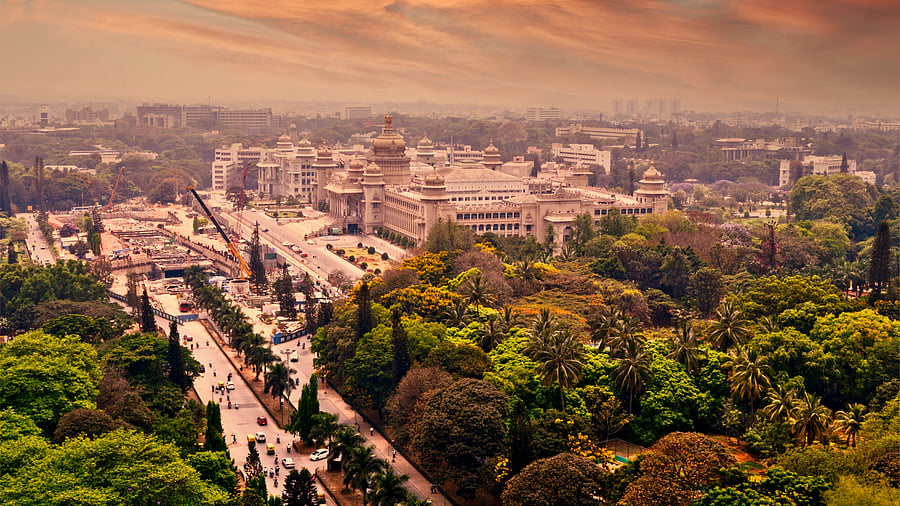
A representative image of Bengaluru city.
Credit: iStock Photo
New Delhi: In a major push to strengthen urban growth, the government will set up seven city economic regions (CERs), including in Bengaluru, Surat and Varanasi, with a proposed allocation of Rs 5,000 crore per region over five years.
The plans will be implemented in a "challenge mode".
Presenting the Union Budget in the Lok Sabha, Union Finance Minister Nirmala Sitharaman described cities as India's engines of growth, innovation and opportunity.
She added that the new initiative would focus on Tier II and Tier III cities, as well as temple towns, which require modern infrastructure and improved basic amenities.
In the Budget 2026-27, the government has proposed over Rs 2,000 crore for two new schemes -- CERs and Regional Medical Hubs.
According to the budgetary document, the allocation has been proposed for seven city economic regions -- Bengaluru, Bhubaneshwar-Puri-Cuttack tricities, Coimbatore-Erode-Tiruppur, Pune, Surat, Varanasi and Vishakhapatanam.
The amount will be used for implementing their plans in a Public-Private-Partnership mode with a reform-cum-results based financing mechanism.
The minister said that the Budget aims to further amplify the potential of cities to deliver the economic power of agglomerations by mapping CER, based on their specific growth drivers.
"An allocation of Rs 5,000 crore per CER over 5 years is proposed for implementing their plans through a challenge mode with a reform-cum-results based financing mechanism," Sitharaman said.
She said that during the past decade, her government has undertaken several initiatives for large-scale enhancement of public infrastructure, including through new financing instruments such as Infrastructure Investment Trusts (InVITs) and Real Estate Investment Trusts (REITs) and institutions like NIIF and NABFID.
The government will continue to focus on developing infrastructure in cities with over 5 lakh population (Tier II and Tier III), which have expanded to become growth centres.