
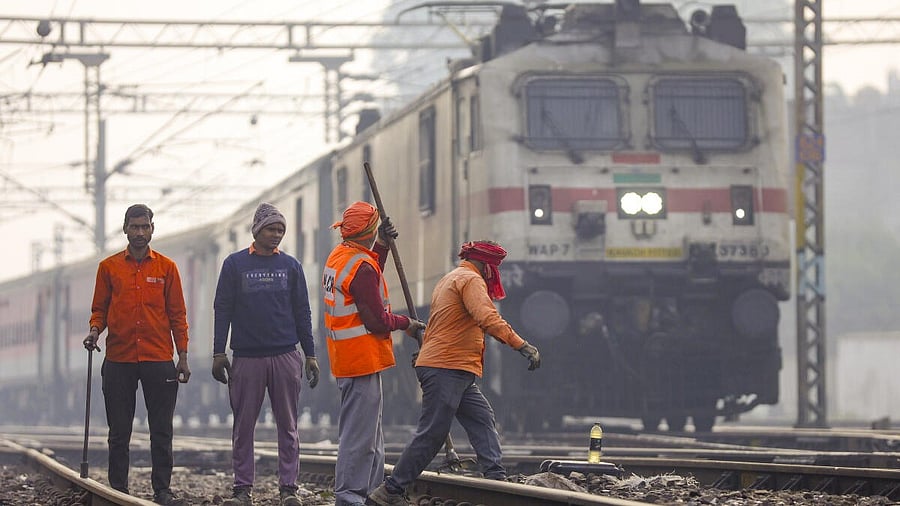
Workers mending railway tracks in Prayagraj, Uttar Pradesh.
Credit: PTI
The Railways has been allocated its highest-ever budgetary outlay of Rs 2,78,030 crore for 2026-27, up from the allocation of Rs 2.65 lakh crore in the 2025-26 Budget.
Union Finance Minister Nirmala Sitharaman, in her Budget speech, announced a total capital expenditure of Rs 2.93 lakh crore for the Railways, which will focus its spending on strengthening connectivity, enhancing passenger safety, modernising infrastructure, and expanding freight networks.
Seven high-speed corridors connecting major cities and a east–west dedicated freight corridor between Dankuni in West Bengal and Surat in Gujarat have been announced. The proposed high-speed corridors are: Mumbai–Pune, Pune–Hyderabad, Hyderabad–Bengaluru, Hyderabad–Chennai, Chennai–Bengaluru, Delhi–Varanasi, and Varanasi–Siliguri.
Providing a State-wise break-up of the expenses earmarked for Railway projects from the total capital expenditure outlay, Railway Minister Ashwini Vaishnaw noted that Uttar Pradesh will receive Rs 20,012 crore, Maharashtra Rs 23,926 crore, Rajasthan Rs 10,228 crore, Madhya Pradesh Rs 15,188 crore, Karnataka Rs 7,748 crore, Tamil Nadu Rs 7,611 crore, Kerala Rs 3,795 crore, and Chhattisgarh Rs 7,470 crore.
Major States like Uttar Pradesh are poised for transformation through the proposed Delhi–Varanasi and Varanasi–Siliguri bullet train corridors, aimed at sharply reducing travel time between key economic and cultural centres, strengthening tourism flows, and connecting secondary cities along the route, according to the Railway Ministry.
The Delhi–Varanasi high-speed corridor will enable travel in around three hours 50 minutes. The high-speed rail corridor from Varanasi via Patna to Siliguri in West Bengal will enable travel between Varanasi and Siliguri in about two hours and 55 minutes.
After the completion of the high-speed corridor, Chennai–Bengaluru travel time will take about one hour 13 minutes, Bengaluru–Hyderabad around two hours, Chennai–Hyderabad around two hours 55 minutes, Mumbai–Pune around 48 minutes and Pune-Hyderabad travel time will be around one hour 55 minutes, according to the Ministry.
In Jammu and Kashmir, the Railways will focus on strengthening rail links, including extensions toward Uri to ensure year-round connectivity, benefiting passengers and local economies. Among the projects planned in the northeast is a 40-km underground rail corridor, connecting the region with the rest of the country.
The east–west dedicated freight corridor will start from Dankuni in West Bengal and pass through Odisha, Chhattisgarh, Madhya Pradesh, and Maharashtra to reach Surat in Gujarat. "It will provide connectivity to the Vadhavan Port (in Maharashtra's Palgarh), which will become one of the largest ports in the world," Vaishnaw said at a press conference.