
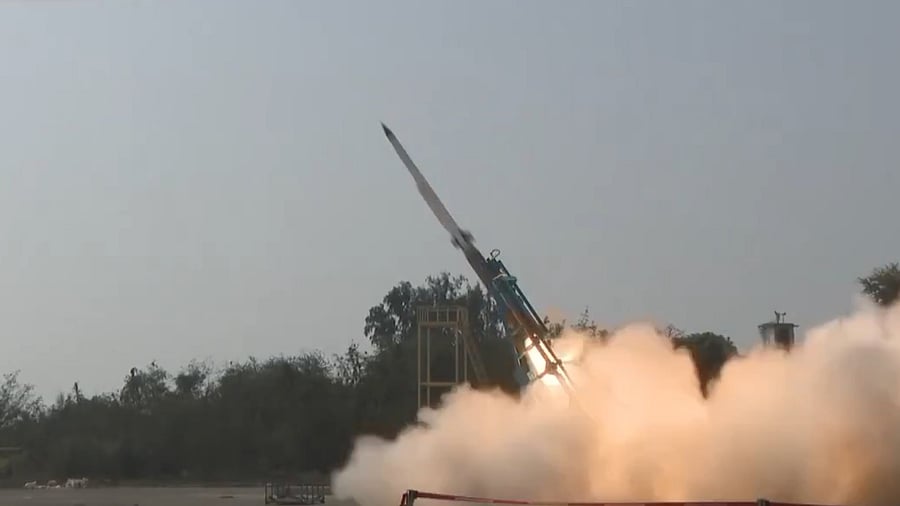
Solid Fuel Ducted Ramjet (SFDR) technology was successfully flight tested from the Integrated Test Range (ITR), Chandipur off the coast of Odisha
Credit: X/@DRDO
New Delhi: The Defence Research and Development Organisation on Tuesday carried out a successful demonstration trial of the home-grown ramjet engine technology, as it aims to perfect a closely guarded technology for making long range air-to-air missiles.
“The demonstration of solid fuel ducted ramjet technology was conducted from the Integrated Test Range, Chandipur at around 1045 hours. Its success places India into an elite league of nations having such a technology that enables developing long-range air-to-air missiles to give tactical edge over the adversaries,” said an official.
SFDR is an advanced missile propulsion technology on which the DRDO has been working for over a decade.
This will be at the core of the futuristic Astra Mk-III beyond visual range missile with a range of 190 km to 240 km, depending on the target’s altitude.
The defence research agency carried out the first trial in 2018 after which a few more tests were conducted in the process of evaluating the technology. The test on Tuesday off the coast of Odisha happened four years after the last one.
The performance of the system was confirmed by the flight data captured by a number of tracking instruments deployed by ITR.
“All the subsystems including nozzle-less booster, solid fuel ducted ramjet motor and fuel flow controller performed as per expectations after being initially propelled by a ground booster motor to the desired Mach number,” the ministry said in a statement.
The SFDR-based propulsion would enable the missile to intercept aerial threats at very long range at supersonic speeds, officials said.
Three DRDO laboratories - Defence Research and Development Laboratory, Hyderabad; High Energy Materials Research Laboratory, Pune; and Research Centre Imarat, Hyderabad – are working on this project.