
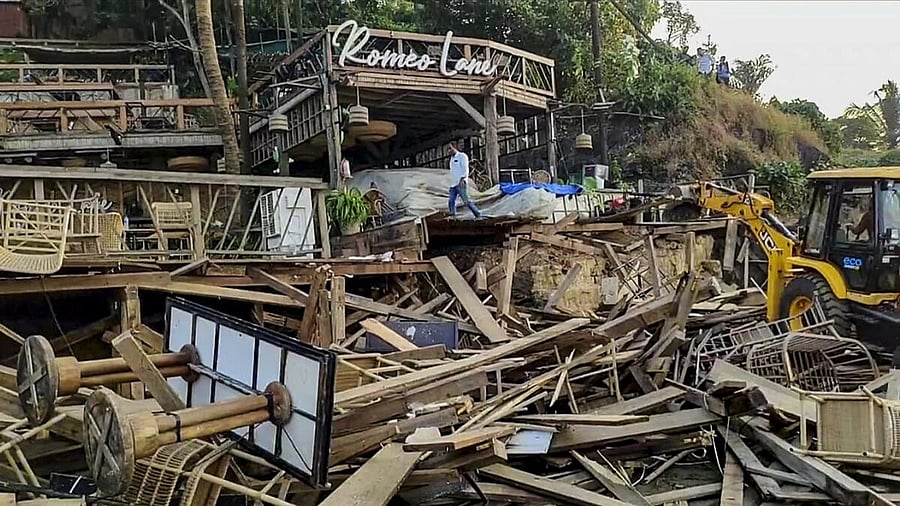
An excavator demolishes wooden structures at Romeo Lane on Anjuna beach after a fire at the adjacent Birch by Romeo Lane nightclub.
Credit: PTI photo
Hours after 25 people perished in a massive blaze in a nightclub in Goa on Saturday night, the Luthra brothers—Gaurav and Saurabh (owners of the club) fled the country evading a trial on alleged negligence and murder.
The brothers took an early morning IndiGo flight at 5:30 am and fled to Phuket in Thailand to seek refuge.
The fire occurred at a nightclub called Birch by Romeo Lane in Arpora. This club is situated 25 km from the capital Panaji.
Investigations into the deadly fire have revealed several discrepancies like structural deficiencies as well a complete disregard of fire safety norms.
The club—which was located on the backwaters of Arpora lake had very narrow exit doors. Furthermore, these doors were connected only by a narrow bridge which made escape from the burning building a herculean task.
Moreover, a demolition notice was also issued against the property but it got a stay from the Directorate of Panchayat.
On Tuesday, Goa Tourism Department demolished ‘Romeo Lane’, a beach shack illegally constructed at Vagator.
An FIR has been registered against the brothers and a Look Out Circular was issued against them by December 7 by the Bureau of Immigration (BOI) at the request of the Goa Police.
After they fled, the Goa Police immediately dispatched a team to Delhi to conduct raids on the addresses of the accused Gaurav and Saurabh Luthra.
Later on, Goa Police approached the CBI for issuance of an Interpol Blue Notice against Saurabh and Gaurav Luthra.
Up till now, the police have arrested six people including co-owner Ajay Gupta, nightclub’s chief general manager Rajiv Modak, general manager Vivek Singh, bar manager Rajiv Singhania, gate manager Riyanshu Thakur and employee Bharat Kohli.
India-Thailand extradition
Since 2015, India and Thailand have an extradition treaty in place. This treaty allows extradition of any person who is wanted for trial or for the imposition or enforcement of a sentence by one 'Contracting State' and is found in the territory of the other 'Contracting State'.
The treaty states, "Extraditable offences are offences that are punishable under the laws of both Contracting States by imprisonment or any other form of deprivation of liberty for a period of at least one year, or by a more severe penalty. "
Thus, only those offences which are punishable by at least one year of imprisonment in both countries qualify.
A request for extradition shall be made in writing and transmitted to the Central Authority of the Requested State through diplomatic channels.
The requesting authorities must provide comprehensive documentation including:
Formal extradition request with detailed charges
Warrant of arrest or judgment of conviction
Statement of facts and applicable laws
Evidence supporting the charges
Assurance regarding treatment and trial procedures
Where extradition is granted, the Requested State shall surrender the person from a convenient point of departure in the Requested State as agreed by the Contracting States.