
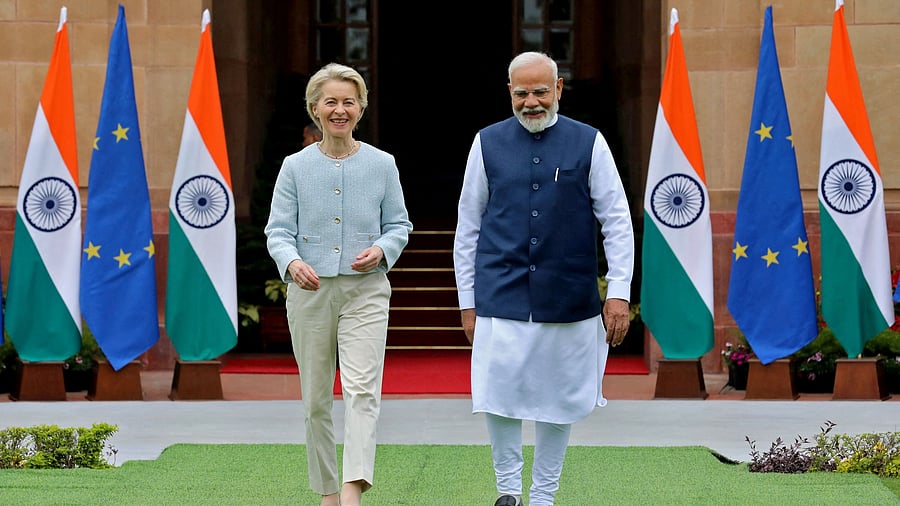
Prime Minister Narendra Modi and European Commission President Ursula von der Leyen.
Credit: Reuters Photo
India-EU Summit LIVE Updates | India-EU summit to lay broader vision to navigate geopolitical tensions
Top leaders of India and the European Union will on Tuesday announce the conclusion of negotiations for a landmark trade deal, firm up a strategic defence pact and unveil a broader vision to navigate the geopolitical turbulence and trade disruptions.
Prime Minister Narendra Modi will host European Commission President Ursula von der Leyen and European Council President Antonio Costa for summit talks against the backdrop of new fissures in ties between Europe and the US.
Costa and von der Leyen graced the 77th Republic Day celebrations at the Kartavya Path as chief guests on Monday.
"A successful India makes the world more stable, prosperous and secure. And we all benefit," Von der Leyen said ahead of the summit.
The world has been witnessing new geopolitical upheavals triggered largely by Washington's policies on trade and security.
The long-awaited India-EU free trade agreement, billed as "mother of all deals" is expected to significantly expand the overall trajectory of two-way engagement as it will open up new opportunity for cooperation in diverse areas.
(PTI)
India-EU Summit LIVE Updates | Traffic curbs imposed as EU leaders set to visit Delhi's Rajghat
Traffic movement in and around Rajghat and adjoining areas in the national capital will be restricted for a few hours on Tuesday morning to facilitate European Union leaders to visit the memorial and pay their respects to Mahatma Gandhi.
The official event at Mahatma Gandhi Smriti Sthal, to be attended by the visiting EU delegation along with other dignitaries, will be held between 9.15 am and 12.30 pm.
Special traffic arrangements will be in place to ensure its smooth conduct, according to a traffic advisory issued by the Delhi Police.
Diversions will be imposed "as and when required" at key junctions, including at ITO Chowk, Delhi Gate, Guru Nanak Chowk, Shantivan Chowk, Rajghat DTC Depot and IP Flyover, the advisory stated.
(PTI)
India-EU Summit LIVE Updates | 'The signing of the Security and Defence Partnership is a milestone, and we can build on that': Vice-President of the European Commission, Kaja Kallas
India-EU Summit LIVE Updates | A delegation of the European Union holds a meeting with Defence Minister Rajnath Singh.
This comes after reports surfaced that European Union and India will explore possibilities for India's participation in European defence initiatives
India–EU FTA offers major boost for labour-intensive exports and single-market access," says Dr Arpita Mukherjee
India–EU FTA offers major boost for labour-intensive exports and single-market access," says Dr Arpita Mukherjee Professor at ICRIER.
India-EU free trade pact: What's agreed, what's at stake after years of talks
Ratification and Impact
Once signed, and ratified by the European Parliament, a process that could take at least a year, the pact could expand bilateral trade, and lift Indian exports such as textiles and jewellery, which have been hit by 50% U.S. tariffs since late August.
However, a vote by EU lawmakers earlier this week to challenge the EU-South America pact in the bloc's top court highlights how parliamentary hurdles could delay or complicate ratification.
Investment protection and geographical indications (GIs) are being negotiated separately, narrowing the FTA's focus to goods, services and trade rules.
Why it matters now
The pact would be India's ninth trade agreement in four years, reflecting New Delhi's push to secure market access as global trade turns more protectionist. For the EU, the deal supports supply-chain diversification and reduces reliance on China, while tapping India's fast-growing $4.2 trillion economy.
Gains for India
The EU is among India's top trading partners, along with the United States and China, with total bilateral goods and services trade exceeding $190 billion in 2024/25. India exported about $76 billion in goods and $30 billion in services to the 27-nation bloc.
Average EU tariffs on Indian goods are relatively low at about 3.8%, but labour-intensive sectors such as textiles and garments face duties of around 10%, according to Global Trade Research Initiative, a Delhi-based think tank.
The FTA would help restore competitiveness lost after the EU began withdrawing tariff concessions under Generalised System of Preferences (GSP) in 2023, on products including garments, pharmaceuticals and machinery, and offset the impact of higher U.S. tariffs.
India is also seeking access for its professionals and export of IT services.
Gains for EU
EU exports to India face much higher barriers, with a weighted-average tariff of about 9.3% on $60.7 billion of goods in 2024/25.
Duties are particularly steep on automobiles, auto parts, chemicals and plastics. Tariff cuts would open opportunities in cars, machinery, aircraft and chemicals, while improving access to services, procurement and investment in one of the world's fastest-growing large markets.
India-EU Summit LIVE updates | Duty cuts on labour-intensive sectors, cars, wines likely part of India, EU FTA
They said the pact is also expected to include liberalisation of norms in several services sectors.
Read more
India-EU Summit LIVE updates | EU and India to explore defence cooperation, draft document says
The European Union and India will explore possibilities for India's participation in European defence initiatives, according to a draft security and defence partnership document seen by Reuters.
Read more
India-EU Summit LIVE updates | India, EU wrap up talks for landmark trade deal amid strained US ties
'The deal will propel trade and investment between both sides,' said India Trade Secretary Rajesh Agrawal.
Read more