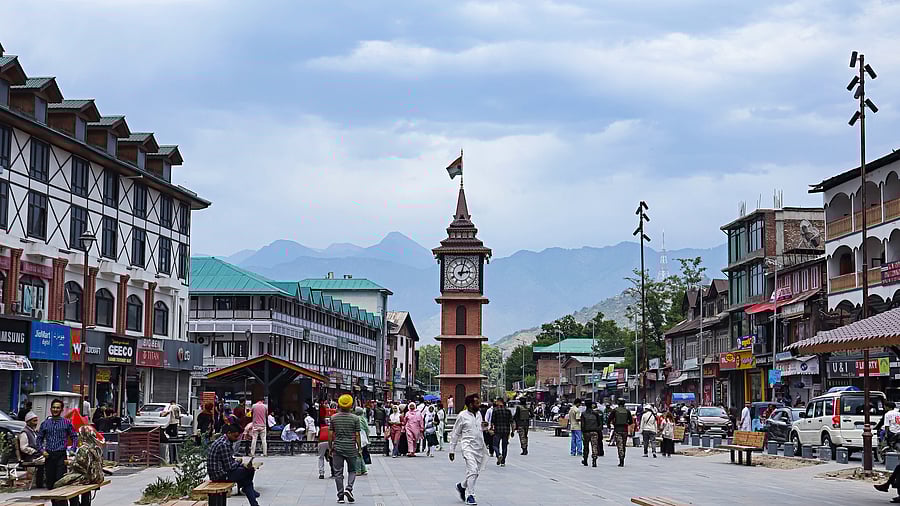
The Lal Chowk in Srinagar, Jammu and Kashmir. Disputes over institutions and admissions in the Union Territory are increasingly taking on regional and communal overtones.
Credit: iStock Photo
Srinagar: Political fault lines in the Union Territory have sharpened, with education emerging as a new flashpoint in the Jammu–Kashmir divide, as disputes over institutions and admissions increasingly take on regional and communal overtones.
The latest controversy centers on the proposed National Law University (NLU), which has sparked protests in Jammu even as the government maintains that no final decision has been taken on its permanent location.
The issue has been simmering since October last year, when the Jammu and Kashmir Assembly passed a resolution seeking an NLU in Kashmir — a move opposed by the BJP.
Chief Minister Omar Abdullah accused critics of politicising the matter, noting that when both an IIT and an IIM were sanctioned for Jammu in 2016, there was no comparable protest from Kashmir.
“Nobody talked of parity then,” he said, rejecting claims that locating the NLU in Kashmir would disadvantage Jammu. Notably, Kashmir has neither an IIT nor an IIM, although IIM Jammu opened a camp office in the Valley in 2020.
The BJP and allied organisations in Jammu insist the NLU be established in their region, citing better connectivity and infrastructure. The party has warned of protests if the university is located in Kashmir, effectively turning what officials describe as an administrative decision into a regional political confrontation.
The NLU row comes on the heels of an even more contentious education-linked controversy in Jammu. The National Medical Commission (NMC) recently withdrew permission for the newly established Shri Mata Vaishno Devi Institute of Excellence Medical College to run its MBBS programme. The move followed sustained protests by Hindu groups after 42 of the 50 students admitted through the merit-based NEET exam were Muslims, many from the Kashmir Valley.
While the NMC cited deficiencies in infrastructure and compliance, leaders in Kashmir alleged the decision was influenced by political pressure from the BJP and its right-wing ecosystem, angered by the religious composition of the first batch. The closure has left students uncertain about their academic future and fuelled accusations that merit is being subordinated to identity politics.
These disputes are not isolated. Earlier, groups in Jammu protested what they described as the “domination” of Kashmiri Muslims in Jammu and Kashmir’s senior football team and the under-14 cricket side, highlighting how representation in competitive spaces — from sports to education — is increasingly framed as a regional and communal contest.
Taken together, the controversies over the NLU, the medical college, and even sports teams reflect a deeper shift in the Union Territory's politics. Education and merit-based competition are no longer insulated from regional anxieties, with institutions themselves becoming symbols in the Jammu–Kashmir power balance.
As political parties trade accusations and street protests escalate, observers warn that education, once a bridge between Jammu and Kashmir, is fast becoming another line of division in an already polarised landscape.