
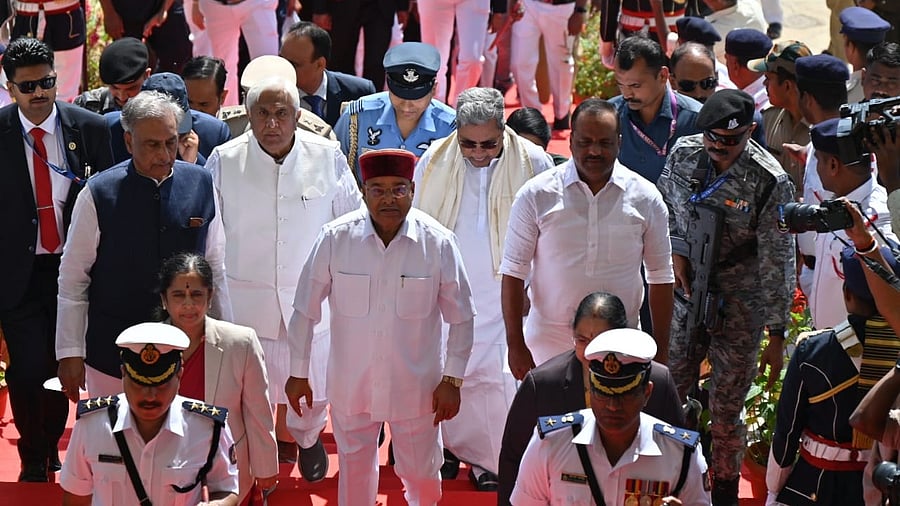
Governor Thawarchand Gehlot arriving at the Vidhana Soudha in Bengaluru on Thursday.
Credit: DH Photo/B K Janardhan
Bengaluru: Karnataka faces “a suppressive situation in economic and policy matters” in the federal setup, the Congress government said in a scathing attack on the Narendra Modi administration through Governor Thaawarchand Gehlot’s curtailed address to the joint legislature session Thursday.
“The Union government must seriously consider that economically suppressing Karnataka, which occupies a driving position in the national economy, will adversely affect the entire country,” the government stated, pointing to “injustice” in tax devolution, Centrally-sponsored programmes and other schemes.
Under the 15th Finance Commission, the government said the State was “denied” resources worth Rs 1.25 lakh crore. “...this grave injustice has been brought to the notice of the 16th Finance Commission. The government is firmly confident that this injustice will be rectified in the coming days,” it stated.
The Congress government demanded the scrapping of the “contractor-centric” Viksit Bharat-Guarantee for Rozgar and Ajeevika Mission (Gramin) Act. It also sought restoration of the Mahatma Gandhi National Rural Employment Guarantee Act (MGNREGA).
“Worker-centric rights under the MGNREGA have been diluted and labourers are being placed under contractors’ control,” the government said, adding that it would lead to “large-scale corruption”.
These are among paragraphs that Gehlot wanted dropped.
The new law is designed to protect “corporate capitalist interests”, the government stated. “As a result, the noble objectives of rural asset creation and providing employment to labourers at their place of residence have been reduced to nothing,” the government stated, calling it an “anti-progressive”.
The MGNREGA was “a monumental chapter” for rural India, the government said. Its repeal “has deprived rural wage labourers, small farmers, and women of their rights to employment and unemployment allowance,” it stated.
The MGNREGA was launched in 2005 in line with Mahatma Gandhi’s vision to make villages independent and autonomous, the government said. “Over the last 20 years, the State has undertaken 76.89 lakh works under this scheme at a cost of ₹61,030 crore and generated 182.5 crore person-days of employment,” it stated.
While the MGNREGA addressed distress migration, the government charged that the new law would see officials in Delhi decide where employment would be provided. The VB-G RAM (G) Act “reinstates migration to cities in search of employment,” the government said.
“Under the new law, States already facing financial stress due to Union policies must contribute 40% of the funding,” the government stated. “If States fail to contribute, the Centre will withhold funds, leading the scheme towards gradual extinction.