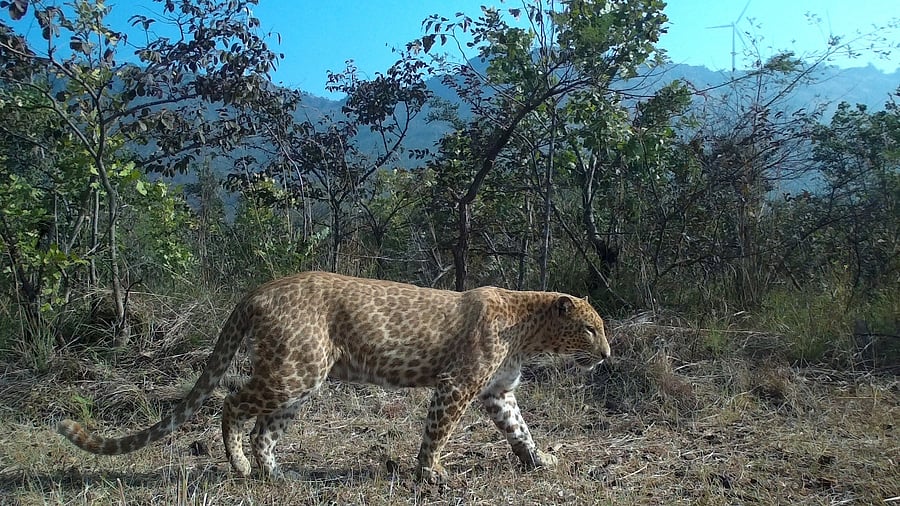
The leopard with colouration.
Credit: Special arrangement
Bengaluru: A big cat with an unusual colouration has been documented in the Vijayanagara district with researchers stating that the sighting of the 'sandalwood' leopard is the second confirmation documentation in the country.
Conservationist Sanjay Gubbi and his team from the Holematthi Nature Foundation (HNF) documented the female leopard, estimated to be 6-7-year old, through camera trapping.
In one of the later images, the female was photographed with a cub that displayed normal coat colouration and black rosettes.
HNF said leopards usually have tawny coats with black rosettes but the exceptionally colour morph exhibits a pale reddish-pink coat resembling the "hue of sandalwood" with light-brown rosettes.
Internationally, leopards of this colour morph are referred to as "strawberry" leopards. They have been recorded in South Africa and Tanzania.
"In India, Sandalwood Leopards are extremely rare. A single individual was previously documented from the Ranakpur region of Rajasthan in November 2021, making the Vijayanagara record only the second confirmed documentation from the country," it said.
Gubbi said the colouration was consistent with conditions such as hypomelanism or erythrism, both of which are naturally occurring genetic traits identified in wild mammals.
"At present, this assessment is based on photographic evidence and visual characteristics. While these features are distinctive, confirmation of the exact genetic mechanism would require molecular analysis using DNA from non-invasive samples such as scat or hair. Until such genetic evidence is available, it is scientifically appropriate to describe this animal as a rare colour morph rather than assign a specific genetic condition,” he explained.
Camera trapping was conducted as part of CHINA's efforts to estimate leopard populations and identify key landscapes for large mammal conservation in the Kalyana-Karnataka region.
HFs research indicates that overall, Karnataka supports an estimated 2,500 leopards.