
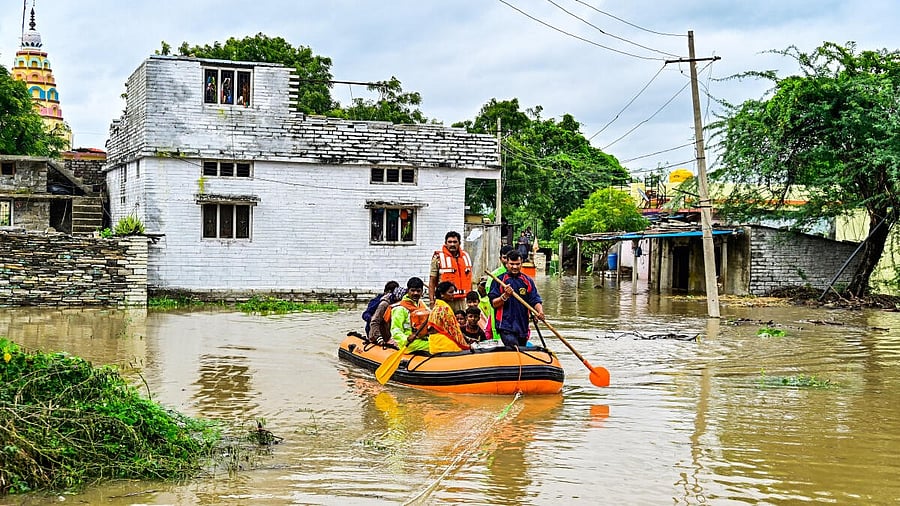
SDRF personnel and firemen rescue people from a flooded area in Somanathahalli of Kalaburagi district
Credit: DH photo/Tajuddin Azad
Karnataka witnessed a series of extreme weather events in 2025. The first half of the year saw many districts grappling with high temperatures and heatwaves, followed by intense rainfall. As per the Climate India 2025, An Assessment of Extreme Weather Events - January to September report, on 52 of the 273 days, India experienced heatwaves; Karnataka recorded one day of heatwave.
As the year draws to a close, 2025 served as a stark reminder of how 'fragile' Karnataka's landscape is. The State witnessed a series of extreme weather events that left behind widespread damage to human beings, animals and crops. Here is a weather recap for Karnataka.
Heatwave in March
The World Meteorological Organization (WMO) defines a heatwave as an extended period of abnormally hot weather, often with high humidity, that noticeably affects human activities and health.
In March this year, several places, including Ghadasai and Mavinkurve in Uttara Kannada district, recorded the highest maximum temperature of 42.2 degrees celcius, according to a report published by Deccan Chronicle, citing data from the Karnataka State Natural Disaster Monitoring Centre (KSNDMC).
The scorching heat hit many other parts of Uttara Karnataka in March, as Savantvada recorded 41.1 degrees and Pala 41.7 degrees, and Raichur's Lingsugur recorded 41.6 degrees.
In Dakshina Kannada, the temperatures were similar: Kadaba recorded 41.3 degrees; Kurdi in Raichur district 41.2 degrees, while Salgundi in the district recorded 41 degrees celcius.
The KSNDMC data show that a total of 19 locations in Uttara Kannada recorded high temperatures above 38 degrees during the month. While Dakshina Kannada had nine locations under the high temperature lens, Raichur had five, Bidar had four, and Dharwad, Kalaburagi, and Udupi had three each. Additionally, Koppal, Shivamogga, and Kodagu had one location each of high temperatures, whilst Vijayanagara recorded two.
Vulnerable districts
According to reports, 15 districts in Karnataka are highly vulnerable to heatwaves — Bidar, Kalaburagi, Vijayapura, Yadgir, Raichur, Bagalkot, Belagavi, Koppal, Ballari, Gadag, Dharwad, Haveri, Vijayanagar, Davangere, and Chitradurga.
The districts of North Interior Karnataka are prone to high temperatures for a longer duration of the year.
According to the 'Karnataka State Heatwave Action Plan 2024-2025' by the Karnataka State Disaster Management Authority, heatwaves are increasing in frequency and severity, and "heat waves worldwide have become more extreme and frequent due to a human-influenced climate change and global warming."
The report also labelled heatwaves a "silent-disaster". "Devastating weather phenomena like successive droughts, floods, fires, landslides, hailstorms, lightning, heat waves, and strong surface winds have been causing loss of life and property in the State," it stated.
Heavy rains, floods and landslides
In 2025, Karnataka experienced 28 days of lightning and storms, claiming 54 lives. As many as 106 days saw heavy rain, floods, and landslides, due to which 63 people lost their lives.
As per reports published in September, since April 1, 111 rain-related deaths were reported in Karnataka, as stated by Chief Minister Siddaramaiah. "This year, from April 1 to September 7, as many as 111 human lives were lost due to rain-related incidents," he had said.
He had noted that a compensation of Rs 5 lakh was given to the families of each of the deceased, totalling around Rs 5.5 crore. Additionally, Rs 24.3 crore in total was given to those whose houses were damaged.
Col C P Muthanna (retd), founder and honorary secretary of the Environment and Health Foundation (India), while speaking to DH about the rain conditions in the State, said, "Heavy rainfall increases the risk of landslides and loss of lives."
"In Karnataka, especially in the Western Ghats, the landscape is extremely fragile. What is worrisome is the scale of disturbance, conversion of land for layouts and resorts, unregulated tourism, the proposal for railways, and so on. Every intervention weakens the land. When there is heavy rainfall, the damage multiplies, like landslides, loss of lives, and destruction," he added.
Karnataka, even though in previous years reported low mortality due to heatwaves, certain parts of the North Interior Karnataka remain vulnerable to the phenomenon, as many of these are bordering districts of Telangana and Andhra Pradesh, the Karnataka State Heatwave Action Plan stated.
Loss of crops and lives claimed
In Karnataka, 117 deaths were reported in 2025 in 120 days that witnessed extreme weather events. The report also compares the death toll with previous years:
In all, 944 animal deaths were reported in Karnataka from January 1 to September 30, with Karnataka being the only southern State to report animal fatalities, according to the Climate India 2025 report. Meanwhile, 3,849 houses were damaged as the South Peninsula region recorded extreme weather events on 205 of 273 days. Beyond human loss, the weather in Karnataka left behind damage to homes, and agriculture. Crops on about 14.58 lakh hectares were damaged in the State.
In November, Karnataka Chief Minister Siddaramaiah initiated the payment of an additional input subsidy of Rs 1,033.6 crore to 14.24 lakh farmers who suffered crop losses due to heavy rainfall during the monsoon this year. As a top-up to help flood-hit farmers, the government hiked input subsidy from Rs 8,500 to Rs 17,000 per hectare for rain-dependent crops, Rs 17,000 to Rs 25,500 for irrigated crops, and Rs 22,500 to Rs 31,000 for multi-year crops.
As we head towards 2026, looking at how Karnataka responded to the extreme weather this year, experts say there is a need to mitigate the effects of these extreme weather events and look at the plausible road maps for the future. “Extreme weather events will occur because of forces beyond our control. What we can do is to mitigate the damage that will occur,” Col C P Muthanna said.