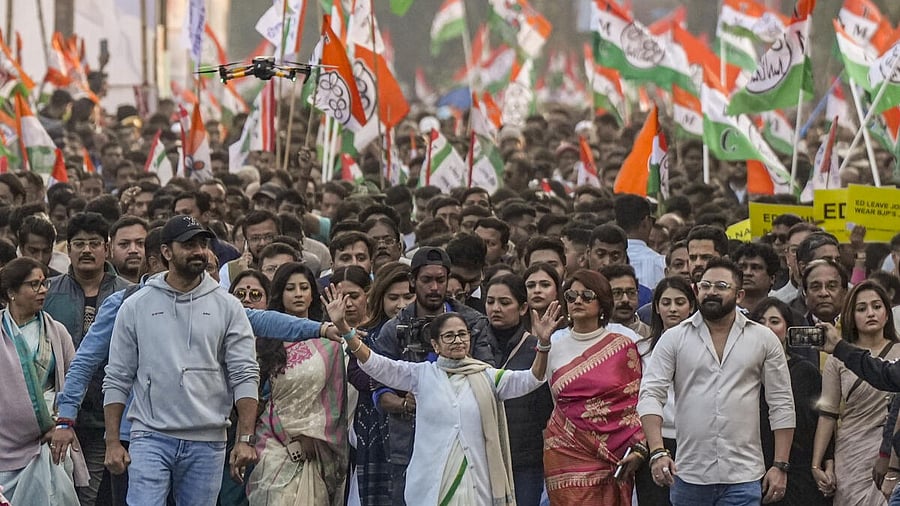
I-PAC row: CM Mamata leads protest march in Kolkata against ED action.
Credit: PTI
In a dramatic escalation of political tensions, the Enforcement Directorate (ED) launched raids on January 8, targeting the premises of the Indian Political Action Committee (I-PAC), a political consultancy firm working with the ruling Trinamool Congress (TMC). The raids, connected to a 2020 coal smuggling investigation involving hawala transactions, unfolded without evident co-ordination with local authorities, leaving even Kolkata's law enforcement apparatus surprised.
The central agency's approach seemed designed to maximise the element of surprise, but it quickly spiralled into chaos when West Bengal's Chief Minister Mamata Banerjee intervened personally, rushing to the sites, and retrieving what she described as party documents. This bold move not only thwarted the immediate objectives of the raids, but also transformed them into a public spectacle, underscoring the deepening rift between federal authority and state autonomy. Rather than serving the cause of justice, the action has reignited debates about overreach, especially in the shadow of the upcoming 2026 Assembly polls.
Questions have arisen about the legality of such interference, with the Bharatiya Janata Party (BJP) arguing that Banerjee’s involvement sets a dangerous precedent. Yet, the reality on the ground reveals a pattern of unpreparedness on the part of central agencies. Historical precedents abound: in 2021, when the Central Bureau of Investigation (CBI) arrested TMC ministers and senior leaders in a sting operation case, Banerjee arrived at the agency's office and staged a prolonged sit-in, effectively turning the tables.
Similarly, in 2019, attempts to detain Kolkata's then-police commissioner Rajeev Kumar, in connection with a chit fund scam, led to local police detaining federal officers, prompting a constitutional standoff that required judicial intervention. More recently, in the Sandeshkhali incident, locals assaulted ED officials during an attempt to arrest a local leader, allowing the suspect to escape amid the violence.
These episodes illustrate a recurring theme: central probes in West Bengal often encounter fierce resistance, yet agencies appear ill-equipped to handle such contingencies. In this latest case, the ED has petitioned the Calcutta High Court for a federal investigation into the obstruction. Meanwhile, counter-cases have been filed against ED officials by local police, further muddying the waters.
This incident fits into a broader strategy employed by the BJP, which has repeatedly deployed federal agencies to target Opposition strongholds; like, efforts to corner the TMC leadership through probes into recruitment irregularities, or allegations of shielding unauthorised immigrants to bolster vote-banks. Narratives around citizenship laws and national registers have been weaponised, aimed at portraying the state government as anti-national, or corrupt.
However, these tactics have often misfired, enhancing Banerjee’s image as a fierce protector of regional identity and the underprivileged. With organisational weaknesses plaguing the BJP in West Bengal, these moves smack of desperation. Launching such a high-stakes operation against a seasoned adversary without anticipating the backlash reveals a miscalculation, as the BJP appears to exhaust its arsenal of narratives in a bid to gain ground in the state.
The raids, ostensibly probing links to coal scam proceeds via informal money transfers, threatened to disrupt confidential data flows critical for electoral planning. It is important to note that the ED had earlier questioned Abhishek Banerjee and his family as well in the same case. By framing the action as an attempt to pilfer political intelligence, Mamata Banerjee has rallied her base, portraying it as sabotage ahead of the polls. Politically, this could be interpreted not merely as enforcement but as an optic-driven strike to inflict maximum damage on the Opposition's blueprint, potentially hobbling their media and IT operations at a pivotal moment.
It remains premature to fully gauge the raids' substantive impact or whether they will unearth evidence leading to arrests. However, in terms of perception, where politics often trumps legalities, the optics already tilt in Mamata Banerjee’s favour. She is no ordinary politician; her career, from the 1970s as a street fighter against entrenched regimes, has been defined by resilience and masterful narrative-building. Time and again, direct political confrontations have been spun into tales of victimhood, positioning her as an underdog battling overwhelming odds.
Recall the prelude to the 2021 Assembly polls: an alleged attack left her, which Mamata Banerjee parlayed into a sympathy wave, campaigning from a wheelchair with bandaged limbs, and consolidated support across demographics.
The BJP must reckon with West Bengal's complex voter landscape, which transcends simple communal binaries. A significant portion of the electorate, responds to narratives of regional pride and perceived injustice. Accusations of harassing Bengali voters through selective probes, mistreating migrant workers in other states under the guise of deportation drives, withholding central funds, and now attempting election sabotage via agencies, only amplifies this sentiment. Rather than eroding support, such actions strengthen Mamata Banerjee’s position.
In the end, the Narendra Modi government’s gambit may prove counterproductive, questioning who truly benefits politically when federal might clashes with state defiance. As legal battles unfold, the narrative of resilience could once again propel momentum in unexpected directions, reminding us that in West Bengal, underestimating a proven street-fighter politician comes at a steep cost.
Sayantan Ghosh is an author, and teaches journalism at St. Xavier’s College (autonomous), Kolkata.
Disclaimer: The views expressed above are the author's own. They do not necessarily reflect the views of DH.