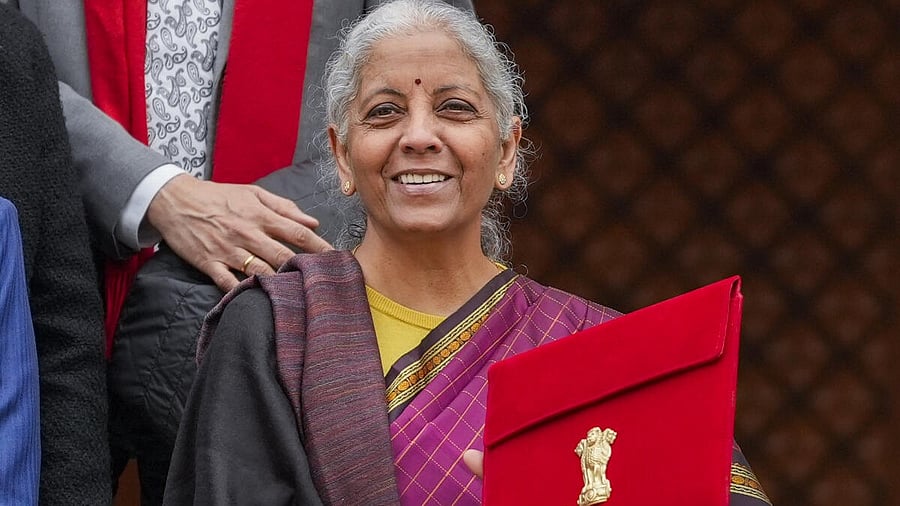
Finance Minister Nirmala Sitharaman on the Budget day.
Credit: PTI Photo
Union Budget 2026 is neither a crowd-pleaser nor a reform blockbuster. Instead, it reads more like a cautious course correction for the Indian economy.
Rather than opting for populist giveaways, the government has chosen fiscal consolidation and continuity. The broad message is clear: stability and long-term planning are being prioritised over short-term market excitement. Whether this approach proves effective will depend on how the private sector and markets respond in the months ahead.
Importantly, this Budget now arrives alongside a major geopolitical and economic development — the announcement that a trade deal between India and the United States is in its final stages. The deal will add a fresh dimension to the overall policy landscape, strengthening India’s external trade prospects, and potentially accelerating investment flows.
The ‘sin industry’ approach to speculation
The most debated aspect of this Budget is the government’s decision to raise the Securities Transaction Tax (STT) on options trading from 0.1% to 0.15% and on futures from 0.02% to 0.05%. The move reflects an emerging view within policy circles that retail speculation, particularly in Futures & Options (F&O) has reached unhealthy levels.
By increasing transaction costs, the government is attempting to discourage excessive speculation, treating high-risk trading much like other socially harmful activities that are taxed to reduce participation.
However, the measure also comes with a clear drawback. Derivatives are not used only for speculation; they are important instruments for hedging and risk management as well. The hike in STT could unintentionally make legitimate hedging more expensive and reduce overall market liquidity. What is intended as a protective step for retail investors may, therefore, have broader side effects on efficient market functioning.
Fiscal prudence, but with growth constraints
From a macroeconomic standpoint, the Budget is firmly anchored in fiscal discipline. The government’s target to bring the fiscal deficit down to 4.3% of GDP in FY2027 signals a commitment to restraint at a time when many global economies continue to spend aggressively. The long-term goal of reducing the Debt-to-GDP ratio to 50% over the next four to five years further reinforces this cautious approach.
At the same time, growth has not been completely sidelined. The ₹12.2 lakh-crore capital expenditure outlay shows that public investment remains the main driver of economic activity.
However, the government is still carrying most of the burden of growth. The real question is whether private investment will finally revive in a meaningful way or whether the economy will continue to depend heavily on public spending. On that front, the Budget offers hope — but not guarantees.
Defence spending is strategic, not sentimental
One area where the Budget takes a clear long-term view is the defence sector. In a world marked by geopolitical uncertainty and shifting global alliances, the increase in defence modernisation spending makes strategic sense. The 24% jump in allocations reflects an effort to strengthen domestic capabilities, and reduce reliance on imports.
This focus on self-reliance is practical rather than ideological. Building a stronger domestic defence ecosystem can create jobs, encourage technology development, and open export opportunities. However, as with many government initiatives, the effectiveness of these allocations will depend on execution, and the ability of Indian companies to scale up efficiently.
A deliberate choice
Perhaps the most telling aspect of Budget 2026 is what it chose not to do. There were no changes to income tax slabs, no major capital gains tax revisions, and no consumer-friendly sops. By keeping these areas untouched, the government has clearly indicated that its priority is macro stability rather than immediate relief.
This decision shifts the narrative away from policy-driven optimism to fundamentals-driven performance. Markets can no longer rely on tax cuts or incentives to fuel rallies. Instead, the focus now moves to corporate earnings and actual business growth.
In many ways, Budget 2026 marks the end of the expectation that every Budget must deliver something exciting for investors. The responsibility for the next phase of growth has effectively been handed over to India Inc.
India-US trade deal
The India-US trade deal is likely to have a structurally positive impact on the Indian economy, though with some sector-specific adjustments. Greater market access to the US can boost Indian exports in pharmaceuticals, engineering goods, textiles, electronics, and IT services, strengthening foreign exchange earnings and job creation.
The agreement also improves India’s attractiveness as a global manufacturing hub, particularly as companies look to diversify supply chains away from China. Higher foreign direct investment, technology collaboration, and smoother regulatory co-operation can accelerate domestic capacity building.
However, there may be short-term competitive pressure on certain domestic industries if tariffs are reduced or import norms are eased. On the balance, the deal tilts clearly in India’s favour — providing an external growth engine that complements the government’s focus on capex-led development and long-term economic stability.
The bottom line
Budget 2026 is a cautious, conservative, and somewhat unsentimental document. It does not attempt to win popularity contests, nor does it aim to ignite immediate market enthusiasm. Instead, it focuses on discipline, stability, and continuity.
Whether this approach is ultimately successful will depend less on government intent and more on private-sector execution. With fiscal policy now largely settled, the future direction of markets and the economy will be determined by Earnings Per Share (EPS) growth and real corporate performance.
The Budget has set the stage. The next act belongs to businesses and investors.