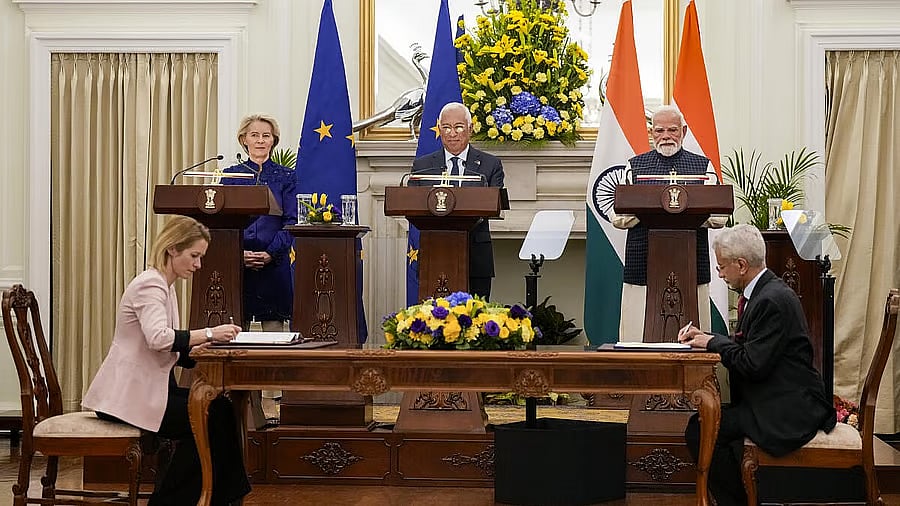
Prime Minister Narendra Modi, European Council President Antonio Costa and European Commission President Ursula von der Leyen witness exchange of documents during a joint press statement after their meeting at the Hyderabad House, in New Delhi.
Credit: PTI Photo
Eighteen years after India and the European Union (EU) began negotiations under the Bilateral Trade and Investment Agreement (BTIA), the trade talks have finally been concluded. Frozen in 2013 due to a ‘mismatch in ambition’, the process was revived in 2022 through three parallel negotiations on trade, investment protection, and geographical indications (GI). While the negotiations on the trade agreement are now complete, the other two negotiations are still ongoing.
Beyond the economic rationale, the prevailing geopolitical context appears to have pushed both to conclude the trade deal, even if it falls short of the depth and comprehensiveness originally envisaged by the EU. India was willing to sign such a deal many years ago; it was the EU that sought a much deeper and more comprehensive agreement, extending beyond trade in goods and services to include investment, public procurement, intellectual property rights, competition policy, and dispute-settlement mechanisms. This shift underscores how geopolitics, and the pressure created by Trump-era tariffs, are compelling major players to redraw their policy priorities and trade strategies.
With the multilateral trading system under severe strain due to the Trump administration’s tariff and non-tariff measures, the agreement will serve as a strong signal of continued commitment by India and the EU to a rules-based trading order. For India, it will also help to diversify part of its export dependence away from the US and towards alternative markets. Both also face their own set of challenges in dealing with a rising and increasingly assertive China. In this context, the agreement could also serve as a building block for broader economic partnerships in the Indo-Pacific.
Although the legal text has not yet been finalised, both the European Commission and the Indian government have released key elements of the agreement. As per the European Commission, the EU will remove tariffs on more than 90 per cent of tariff lines (accounting for 91 per cent of trade value), while India will eliminate tariffs on 86 per cent of tariff lines (covering 93 per cent of trade value) over time.
The deal will also liberalise trade in services, including telecommunications and professional services, and incorporate chapters on the protection and enforcement of intellectual property (IP) rights, along with commitments on environmental protection, sustainable development, and labour standards. Any linkage with the carbon border adjustment mechanism (CBAM) is not clear at the moment. The sectors expected to benefit immediately include textiles and garments, leather products, chemicals, gems and jewellery, fisheries, and pharmaceuticals.
India has sought to protect the interests of farmers and small and medium enterprises, while accommodating certain non-trade issues such as labour and sustainability. The EU, for its part, has moderated its expectations on public procurement and immediate market access for several products, including automobiles.
As economics remains at the core of the India-EU partnership, a trade deal will provide fresh momentum across a wide range of areas in which India conducts its business, both within the EU framework and with individual member states. The EU has been, and will continue to be, a key partner in India’s ambitious journey towards a developed economy by 2047, through trade, investment, and technology.
At the same time, India’s large and growing economy, with several globally competitive sectors, remains highly attractive to Europe. All these points are well captured in both the joint statement and the Roadmap 2030, which effectively represents a recalibration of the EU’s India strategy paper launched a few months ago.
However, the real benefits of the trade deal will materialise only if it is complemented by an investment protection agreement. It will, therefore, be crucial for both sides to finalise the investment deal before the enforcement of the trade agreement.
Beyond its signalling value, the FTA will add substantive depth to the India-EU strategic partnership. When trade and investment negotiations stalled, both sides expanded co-operation into other domains. Today, the India-EU institutional architecture comprises more than 40 dialogue mechanisms and working groups covering a wide range of issues, with several new areas proposed under the latest roadmap.
A Connectivity Partnership and the Trade and Technology Council (TTC) are already in place, while the roadmap also outlines enhanced co-operation in technology, innovation, and defence industrial collaboration. Initiatives such as the India-Middle East-Europe Economic Corridor (IMEC) and triangular development co-operation projects are expected to continue providing a positive narrative to bilateral relations.
For India, the deal represents a major step toward trade liberalisation. For the EU, while it may not fully offset trade disruptions with the US or its de-risking strategy vis-à-vis China, it could still secure improved access to India’s rapidly expanding market over the medium term.
(Gulshan Sachdeva is Jean Monnet Chair and Professor at the Centre for European Studies, Jawaharlal Nehru University, New Delhi.)
(Disclaimer: The views expressed above are the author's own. They do not necessarily reflect the views of DH)