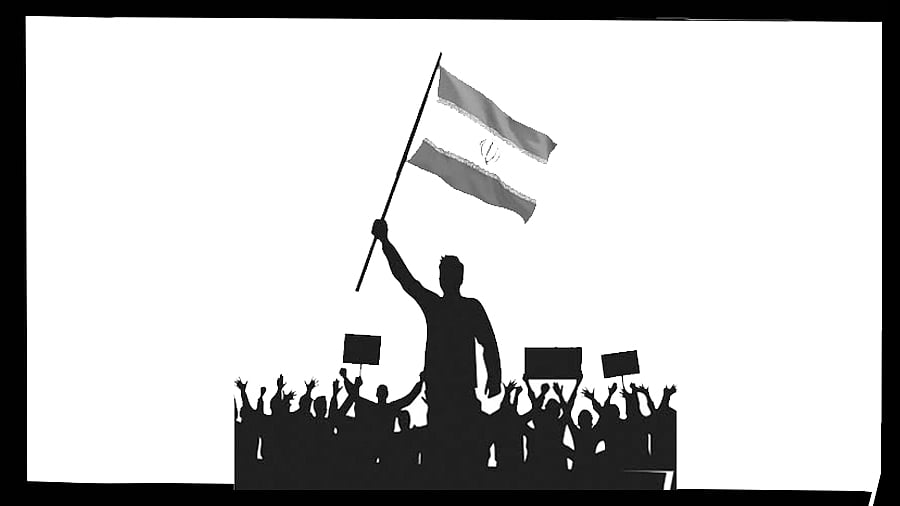
In what could be considered the largest anti-government protest since the 1979 Islamic Revolution, Iranian
citizens have taken to the streets since late December 2025, demonstrating against the regime’s deteriorating economic management and demanding political change.
Rising inflation, exacerbated by Western sanctions, alongside restrictions on women’s employment, has fuelled Iran’s economic crisis. Compounding these grievances are long-standing frustrations over strict social restrictions imposed on women since the theocratic regime assumed power in 1979.
These socio-economic challenges have persisted for years, yet civilian efforts to advocate for reform or transformation have been systematically suppressed by authorities closely aligned with Supreme Leader Ayatollah Ali Khamenei, particularly the Islamic Revolutionary Guard Corps (IRGC).
The ongoing developments underscore widespread disillusionment and a profound desire for comprehensive change in the country.
The swelling protests have fuelled perceptions that the Supreme Leader’s influence is weakening, challenging his legitimacy. However, predicting the regime’s imminent collapse would be premature.
‘Regime change’ would require sustained and substantial grassroots mobilisation within Iran to materialise. Critical questions remain regarding protesters’ resilience against state repression and their capacity to sustain momentum.
Unlike the 1979 revolution, the ongoing uprising lacks a unifying figure, significantly impacting its trajectory and effectiveness. While Reza Pahlavi, son of the deposed Shah of Iran, has appealed for a “free, peaceful Iran” and emerged as a potential alternative to the current regime, it remains unclear whether the Iranian society will accept him as a fitting replacement.
Amid these developments, the regime is likely to remain resilient in preserving theocratic rule, ensuring that the foundational values of the 1979 Islamic Revolution, namely, Shiite ideology, remain intact.
Several plausible scenarios merit consideration regarding Iran’s internal trajectory. First, the regime could become increasingly repressive once the protesters’ momentum diminishes.
While authorities have reportedly halted executions following US pressure, the possibility of full regime control cannot be ruled out.
Second, protesters may continue demonstrating resilience in their commitment towards toppling the regime and achieving political transformation. This outcome would require considerable strength, substantial financial and moral support, and cohesive leadership to guide the movement’s direction. Without clear political and strategic vision, a power vacuum could plunge the country into prolonged socio-political crises.
Third, the regime may be compelled to negotiate with the protesters. This scenario remains uncertain, as the regime’s commitment to preserving Shiite ideology makes substantive compromise on core socio-cultural principles unlikely, though limited economic reforms may be possible.
What does it mean for the US, Israel, the GCC?
Israel: Given its longstanding antagonism with Iran following the 1979 revolution, Israel views regime change as vital, perceiving Tehran as an ‘existential threat’ to its survival. This outcome represents Israel’s preferred resolution to the ongoing crisis. Its immediate concern is Iranian retaliation should the US initiate military operations.
Iranian leadership has already warned that Tehran would strike back against Israel and US bases in the region, with both adversaries having engaged in direct military confrontations in 2024 and 2025.
However, should the Iranian regime survive this uprising, it will continue to pose a major challenge for Israel. Even in the event of a change in government in Iran, rebuilding trust between the two nations that have been completely estranged since 1979 would require considerable effort and time.
The United States: Like Israel, the US seeks a regime in Iran amenable to Washington, Israel, and regional allies. Following the hostage crisis (November 1979 and January 1981), Iran and the US have remained adversaries despite recent attempts to mend ties.
While the Trump administration favours regime change, it remains uncertain whether he would prioritise this or negotiate with the Iranian leadership to avert a regional catastrophe.
Even if the regime survives, the US would seek an Iranian leadership that de-emphasises its nuclear programme for military purposes, ceases support for regional proxies, adopts a less antagonistic posture toward Israel and Arab neighbours, and limits alignment with countries like Russia and China.
Successfully negotiating such a deal would provide the Trump administration greater leverage in pursuing its Middle East policy with fewer constraints.
These demands, however, will be difficult to negotiate given the entrenched mistrust between Tehran and Washington, as well as with Israel. Nonetheless, US military action, including air operations and cyber attacks, against the IRGC-linked establishments cannot be ruled out, a scenario that could engulf much of the Middle East, particularly the Gulf region.
The Arab Gulf States: While neighbouring Arab Gulf states may remain relatively unconcerned as long as uprisings remain confined to Iran, the uncertainty surrounding potential US military action has become a grave concern.
Although a weakened Iran would serve the strategic interests of the Gulf states, they oppose military adventurism from the US or Israel that could trigger a broader regional conflict. This apprehension stems primarily from the high probability of Iran targeting US military bases located in Qatar, Saudi Arabia, Kuwait, Bahrain, the UAE, Iraq, Syria, Jordan, and Turkey.
Compounding this is the potential disruption to oil shipments through the Strait of Hormuz, through which approximately 20% of the world’s oil passes, severely impacting the regional economies that rely heavily on hydrocarbon trade.
Moreover, GCC countries in particular have no desire to be drawn into another conflict as they undertake significant socio-economic reforms programmes aimed at reducing oil dependency.
Disrupting the gradually improving ties with Iran would also be contrary to their interests. This likely explains why Saudi Arabia informed Iran that Riyadh would not allow its airspace or bases to be used for any military operations against Iran. Tellingly, Arab Gulf states prefer a regional balance of power between Israel and Iran and not allowing either rival to exercise dominance over the other.
The current Iranian uprising underscores the deep-seated socio-political and economic problems that have plagued the country under theocratic rule since 1979. Even if the present phase of unrest subsides in the coming days, the underlying grievances demand substantial structural reforms, particularly to improve living standards across multiple fronts.
Such transformations, however, will be a protracted endeavour, as Iran’s challenges are deeply entrenched and cannot be resolved through superficial adjustments alone. The path forward, whether through regime change, negotiated reform, or continued repression, will have profound implications not only for Iran’s domestic stability but also for the broader geopolitical landscape of the Middle East.
The writer is deputy director, Symbiosis School of International Studies, Pune
(Disclaimer: The views expressed above are the author's own. They do not necessarily reflect the views of DH.)