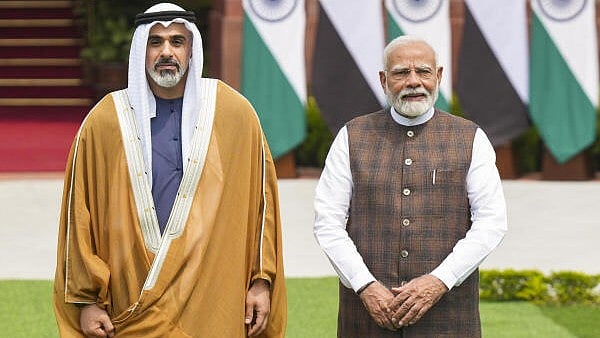
Prime Minister Narendra Modi with Abu Dhabi’s Crown Prince Sheikh Khaled bin Mohamed bin Zayed Al Nahyan.
Credit: PTI Photo
Behind the lighting visit to India by United Arab Emirates President Sheikh Mohammed Bin Zayed Al Nahyan on January 19 hangs a cautionary tale. Do not judge an official visit from abroad by its length or by the number of agreements signed. Evaluate each visit by the sentiments or logic behind them, and look for straws in the wind that can turn into a lodestar for the future of a relationship.
One week after Sheikh Mohammed’s visit, two ministers from each side met in Goa to discuss follow-up actions in a sector vital to the Indian economy, with a critical outcome from the January 19 summit. In Goa, the two ministers were shielded from the typically intense interest in New Delhi generated by the briefness of the UAE president’s visit. The discussions between Petroleum and Natural Gas Minister Hardeep Singh Puri and the UAE’s Minister for Industry and Advanced Technology, Sultan Ahmed Al Jaber, on January 26 prompted Prime Minister Narendra Modi to make a landmark declaration the next day that “India is now on a mission of energy independence, moving beyond energy security.” As the sun sets on an era of discounted oil purchases from Russia, it is the UAE, which will help India become ‘energy independent’.
The global energy industry got the message. Captains of this sprawling industry took their cue from the discussions between Puri and Al Jaber, and what they revealed after their discussions. It would not be an exaggeration to say that the energy world ran away with it. Canada’s Energy and Natural Resources Minister Timothy Hodgson joined Puri in announcing a “renewed” India-Canada Ministerial Energy Dialogue. The ugly spats between New Delhi and Ottawa, which had forced the pull-out of high commissioners on both sides only the other day, have given way to a promised new dawn in their bilateral relations, fuelled by energy compulsions on both sides. The renewed Energy Dialogue is hitherto, the most significant step as India and Canada look to end their diplomatic wrangles of recent years.
Canada is an understated oil and gas giant which wants to move away from supplying almost solely to the United States, now led by its unpredictable President Donald Trump. “Canada used to provide 98 percent of its energy to one customer,” Hodgson told India’s biggest annual energy conclave, the India Energy Week , on January 27. Relying entirely on the US market was a “strategic blunder”, he said. “We are committed to diversifying our supply. We see the opportunity to work with India.”
Canada and the UAE are not the only countries seeking to fill the gap left by a retreating Russia on the Indian oil scene. Twenty-seven CEOs, who included the biggest names in the global energy sector, called on Modi on January 28 and ‘conveyed their keen interest in expanding and deepening their business presence in India,’ according to a readout of the meeting. “Our energy sector is at the centre of our aspirations. There are investment opportunities of 500 billion dollars in this,” Modi tantalised them.
Energy will be only one element — although an important one — in the galloping relationship between India and the UAE that has been catalysed by rapidly shifting and increasingly turbulent international diplomatic developments. In the context of Sheikh Mohammed’s lightning visit, these developments include a West Asia, which is changing beyond recognition, an inability to sustain the special relationship between the UAE and Saudi Arabia, which was the outcome of generational changes in leadership in both countries, and the uncertainties caused by Trump.
In a speech this week, defining the renewed India-UAE relationship, Al Jaber said during his second trip to India in one week that “at the heart of all the megatrends (in the world) sits India” and it “demands a special kind of partnership...that is based on trust and will endure through thick and thin.”
Next in importance to the India-UAE collaboration in energy, Modi and Sheikh Mohammed signalled a new bilateral defence partnership. Not much is likely to be revealed about this compact beyond Foreign Secretary Vikram Misri’s statement at the end of the Summit that “a letter of intent (LOI) was signed between the two sides to work towards concluding a framework agreement for a strategic defence partnership.”
It is significant that the idea of this agreement came after Sheikh Mohammed’s first official visit in December 2025 to Pakistan since becoming president. Although India-UAE relations are not a zero-sum game, the elephant in the room when the defence-related LOI was signed on January 19 was a recent Saudi-Pakistan Strategic Mutual Defense Agreement.
Food security, space co-operation and regional growth promotion in India through special investment vehicles are horizons in India-UAE co-operation that will be concrete outcomes from the Modi-Sheikh Mohammed meeting.
K P Nayar has extensively covered West Asia and reported from Washington as a foreign correspondent for 15 years.
Disclaimer: The views expressed above are the author's own. They do not necessarily reflect the views of DH.