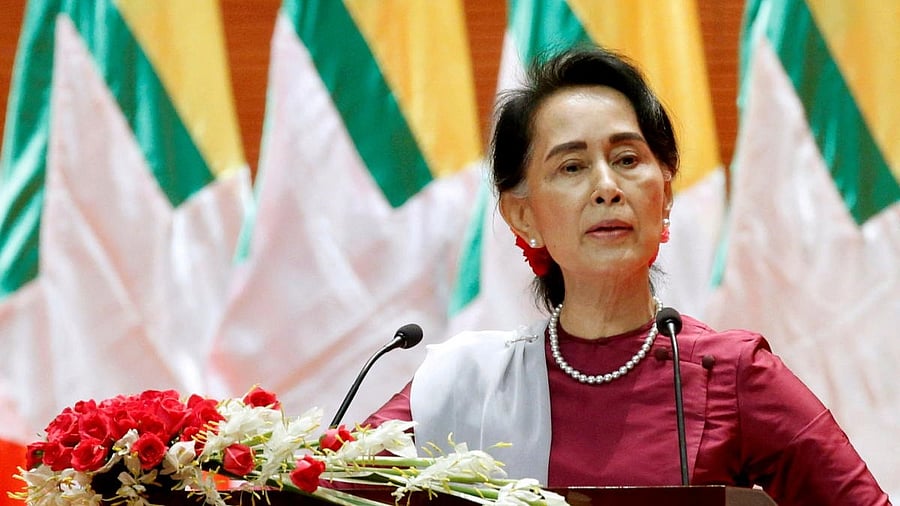
Aung San Suu Kyi
Credit: Reuters File Photo
Where is Aung San Suu Kyi? As the military regime in Myanmar prepares to hold elections to the national parliament on December 28, her absence looms large over an exercise that the junta is pushing through a reluctant country to legitimise its power grab of February 2021.
Suu Kyi, who led her National League for Democracy to a sweeping victory in the 2020 elections, was arrested by the military at the time of the coup. She was reportedly last seen by lawyers in December 2022. Following the exact script that played out in 1990, the military carried out the coup and locked her up because it could not stomach the results of that election. Suu Kyi’s victory was a testimony to her enduring popularity as the country's foremost leader, symbolising its democratic aspirations over the decades. Five years in power as the civilian leader of hybrid civilian-military rule from 2015, and the dimming of her international shine over the Rohingya question, had not diminished her appeal at home. If anything, she was more popular. The party won over 80% of all seats for which elections were held, and could boast a 60% majority in the two houses of parliament, called the National Assembly and the People's Assembly. On the other hand, a party of retired soldiers, the Union Solidarity and Development Party, propped up by the regime, was trounced.
With this, Suu Kyi had arrived at the point where she could have led reforms to the 2008 junta-drafted Constitution. It is a document in which the generals wrote a huge role for themselves, including reserving 25% of nominated seats in parliament for the military. Suu Kyi believed the military stood between the people and their desire to forge a new federal and democratic compact with the various ethnic groups on its peripheries that had yet to accept the writ of the Myanmar State. For ‘the lady’, herself barred by this constitution from becoming the president after the NLD's 2015 election victory, the transition to democracy would be complete only when an elected parliament amended the constitution to cut the military's wings.
But the generals struck first, with a coup in the early hours of the day the newly elected parliamentarians were to take oath, accusing the NLD of election fraud, and deeming the results illegal.
In 2010, after holding Suu Kyi a prisoner in her Yangon house for close to two decades, the military rulers of the time decided to release her. In captivity, she had turned into a global icon of democracy. A cyclone had ravaged Myanmar in 2008. Yet, just 10 days later, the junta held a referendum on the constitution they had drafted, even as devastated people were trying to pick up their lives. Predictably, the junta declared that 90.7% had voted in favour, when in fact, it was facing a severe backlash over its inept handling of the cyclone.
The constitution was the first step in the junta's attempt to fashion itself as a legal entity in a fast-changing world. Holding an election was the next step. But to make it more credible, Suu Kyi, had to be released. Then United States President Barack Obama had said as much to Thein Sein, the head of the junta at the time. Suu Kyi walked free in November 2010. She did not participate in the election, but the world accepted that Myanmar's transition to democracy had been set in motion. Led by Suu Kyi, the NLD participated in by-elections in 2012, and in the next full parliamentary elections in 2015.
As State Counsellor, Suu Kyi walked the extra mile to co-operate with the military side of her government. She even once described the generals in her Cabinet as “sweet uncles”. Suu Kyi would even testify in the International Court of Justice in support of the Myanmar Army when Gambia brought a case against it for carrying out a genocide of the Rohingya, defying demands from international personalities that her Nobel award should be taken back.
This is perhaps the reason there has been no sustained global pressure for her release. India stopped making any meaningful demands for her release back in 2022, not for the sake of the Rohingya, but because of its engagement with the junta. Democracy networks in Myanmar are abuzz with unconfirmed talk that the EVMs to be used in the election have been assembled with parts imported from India. The geopolitical flux set off by US President Donald Trump has only emboldened the junta. Indeed, Trump has declared the situation in Myanmar as normal, and cancelled temporary asylum to Myanmar refugees. Myanmar is among the dozen countries slapped with a US visa ban.
The election is being held even though the vote cannot take place in large swathes of the country over which the military has lost control to armed pro-democracy forces or ethnic militias. According to the Asian Network for Free Elections, of the parties that received 70% of the vote in 2020 and won 90% of the seats, more than half, including the NLD, stand dissolved, as they refused to re-register themselves under a new law brought in by the junta. The junta's proxy, the USDP, is the biggest party contesting nationally, and its candidates are poised to win uncontested in many places. Hundreds have been arrested in the days ahead of the election for advocating a boycott of the poll on social media or in other ways opposing it. The vote will take place amidst continuing violence — a few days ago, the military bombed a hospital in Rakhine, killing 30 people.
The junta is pulling out all the stops to hold this sham election. Suu Kyi's absence makes it even more so.
Nirupama Subramanian is an independent journalist. X: @tallstories.
(Disclaimer: The views expressed above are the author's own. They do not necessarily reflect the views of DH)