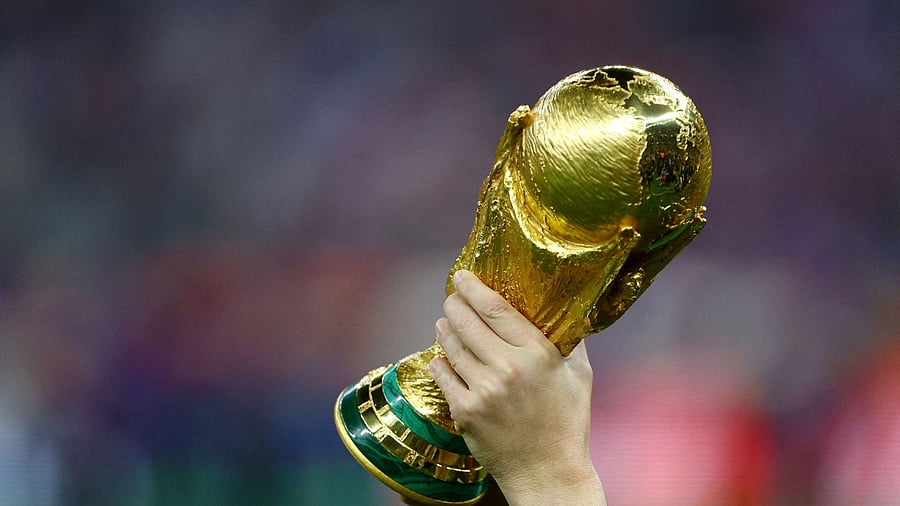
General view of the World Cup trophy.
Credit: Reuters photo
London: Bigger does not always mean better but try telling that to those who govern the world's most popular sport as they reflect on a jam-packed year and begin the countdown to a super-sized World Cup that will dwarf previous tournaments.
World football governing body FIFA -- not to mention continental confederations, national leagues and broadcasters -- will argue that the appetite for the 'Beautiful Game' is insatiable and will point to the past 12 months as evidence.
FIFA described its expanded 32-team Club World Cup as a 'roaring success' with 2.4 million fans attending the summer tournament in the United States, including 81,000 for the final in which Chelsea beat Paris Saint-Germain.
The fact Auckland City FC lost 0-10 to Bayern Munich and 0-6 to Benfica while Al Ain suffered 0-5 and 0-6 defeats raised questions about quality control and such mismatches will litter the World Cup.
A record 48 nations -- up from 32 in Qatar in 2022 -- will descend on the United States, Canada and Mexico for a 104-match tournament that will test the endurance of players, supporters and media to the absolute limit.
Player welfare has already become a flashpoint, with FIFPro warning of rising injury rates and burnout amid an ever-expanding calendar.
Once the likes of Cape Verde, Curacao, Jordan and Uzbekistan have had their moments in the sun, the World Cup will more than likely arrive at its business end with the usual suspects – holders Argentina, France, Brazil, Spain, England and Germany – scrapping for the coveted crown.
Messi and Ronaldo could meet in last dance
Television commentators will require copious notes on some unfamiliar names, but two players will need no introduction.
Argentina's Lionel Messi and Portugal's Cristiano Ronaldo, the two dominant players of the 21st Century, have never faced each other in their five previous World Cups but, if results pan out as expected, could meet for a last dance in a Kansas City quarter-final, by which time Ronaldo would be 41 and Messi 39.
Neither showed any sign of losing their hunger in 2025 with Ronaldo banging in the goals for Al Nassr and helping Portugal to the UEFA Nations League title, while Messi won the MLS Cup with Inter Miami plus the MVP award and MLS Golden Boot.
With the pair away from football's European heartland, other talents have flourished.
None more so than Ballon d'Or and FIFA Player of the Year winner Ousmane Dembele whose goals propelled PSG to a treble, including their first UEFA Champions League title.
Dembele helps PSG finally deliver
Dembele scored 33 goals in 49 appearances in all competitions and made two assists as PSG finally delivered for their Qatari owners by thrashing Inter Milan 5-0 in the final.
He edged some top-notch competition including Lamine Yamal, who played a key role in Barcelona's 28th Spanish title, and Egypt's Mohamed Salah, whose 47 goal involvements (29 goals and 18 assists) powered Liverpool to the Premier League title in a dream first season for Dutch coach Arne Slot.
England captain Harry Kane was only 13th on the list despite finishing as the Bundesliga's top scorer for the second successive season as Bayern Munich claimed the title.
Barca's Aitana Bonmati secured a third consecutive Ballon d'Or Feminin to underline Spain's depth at the top of the women's game although she suffered heartbreak as her country lost the Euro 2025 final on penalties to England.
That tournament continued the surge of the women's game with record-breaking attendances, while FIFA confirmed plans for an expanded Women's Club World Cup starting in 2027.
UEFA's expanded men's Champions League with its 36-team group phase won over the sceptics with 27 clubs still having something on the line in the eighth and final round of matches.
Exciting as that was, the format played into the hands of the big clubs -- none more so than PSG who lost three of their first five games and finished 15th before catching fire in the knockout phase.
Six English clubs qualified for the 2025-26 Champions League -- proof if any were needed that the Premier League is indeed in a league of its own. Its 20 clubs spent a combined three billion pounds ($4.01 billion) in the summer transfer window -- more than the Bundesliga, La Liga, Ligue 1 and Serie A clubs combined.
Technology also evolved in 2025 with FIFA rolling out accelerated semi-automated off-side detection while next year's World Cup will be the most high-tech ever with even the new Trionda ball fitted with an AI chip designed to help match officials get decisions right.