
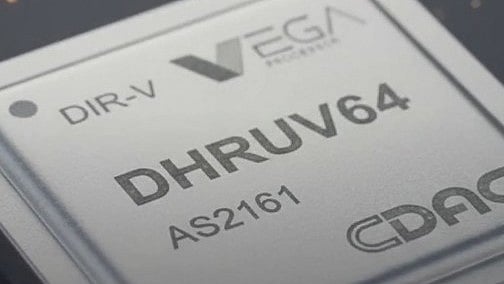
Dhruv64 chipset.
Credit: Press Information Bureau, Government of India/X platform
Microprocessors are the brains of all modern electronics devices, such as ubiquitous smartphones, computers, smart TVs, washing machines, cars, electric buses and advanced medical equipment, defence systems and satellites above the earth's atmosphere.
From the chipset's architecture to its manufacturing process, it is a very complex technology and requires patented technology held by a handful of foreign firms. With so much demand, the chipsets are scarce and expensive for small companies in India.
As per the latest report, India consumes around 20 per cent of all the microprocessors manufactured globally.
To offer a helping hand to Indian tech startups and small and medium consumer electronics manufacturers, Centre for Development of Advanced Computing (C-DAC), which comes under the Ministry of Electronics and Information Technology (MeiTy), has introduced a fully indigenous new generation microprocessor chipset DHRUV64.
DHRUV64 is a 64-bit architecture-based dual-core microprocessor chipset and can clock a peak CPU speed of 1.0 GHz. It is believed to be used in 5G infrastructure, automotive systems, consumer electronics, industrial automation and the Internet of Things (IoT).
Also, DRUV64 will be made accessible to startups, academia, and industry to build, test, and scale indigenous computing products without relying on foreign processors.
Before DHRUV64, the Indian government, in collaboration with globally acclaimed Indian educational institutes, have developed indigenous chipsets.
In 2018, the Indian Institute of Technology-Madras developed SHAKTI. It was designed for strategic, space, and defence applications.
In the same year, IIT Bombay created AJIT, a microprocessor for industrial and robotics applications.
Earlier this year, ISRO–SCL developed VIKRAM, a dedicated processor for space applications such as navigation, guidance, and mission operations; engineered to withstand extreme space conditions.
C-DAC has created THEJAS64 for industrial automation. Now that the DHRUV64 is launched, C-DACi has already begun working on next-generation Dhanush and Dhanush+ processors.
To further propel the Aatmanirbhar Bharat initiative in chipset manufacturing, the government of India has started the Digital India RISC-V (Reduced Instruction Set Computing- 5th gen) programme to offer support needed to design, test and prototype indigenous silicon.
Get the latest news on new launches, gadget reviews, apps, cybersecurity, and more on personal technology only on DH Tech.