
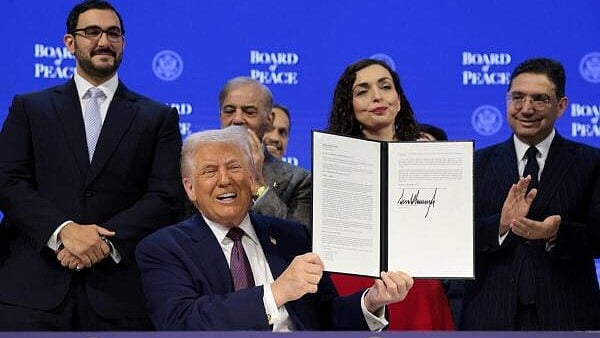
U.S. President Donald Trump takes part in a charter announcement for his Board of Peace initiative aimed at resolving global conflicts, alongside the 56th annual World Economic Forum (WEF), in Davos
Credit: Reuters Photo
Notwithstanding President Donald Trump’s invitation to Prime Minister Narendra Modi, New Delhi decided against showing up at a ceremony held in Davos, Switzerland, for the signing of the ‘Board of Peace’ charter – an event, where the United States leader once again claimed credit for the May 10, 2025, ceasefire between India and Pakistan.
The United States president formally unveiled his Board of Peace on the sidelines of the World Economic Forum in Davos, launching the initiative with the signing of the founding document of the organisation. The leaders of the official representatives of 19 nations attended the event.
Trump’s close partners, like President Javier Milei of Argentina and Viktor Orbán of Hungary, were among the leaders who joined him in signing the document.
The US president was joined by Prime Minister Shehbaz Sharif of Pakistan on the podium at the launch of the Board of Peace, though. Pakistan’s military leader, Field Marshal Asim Munir, was in the audience, too. Trump said that Sharif had praised him for saving 10-20 million lives by mediating the ceasefire between nuclear-armed India and Pakistan and ending the May 7-10, 2025, military conflict between the two South Asian nations.
New Delhi has repeatedly dismissed Trump’s claim about mediating the truce between India and Pakistan, but the US leader continued to claim credit for it.
The Trump Administration positioned the Board of Peace as a global peace-making platform, beginning with the Gaza Strip – the scene of Israel-Hamas conflict since October 2023 – but extending to other conflict zones around the world. The new organisation’s charter, which was signed in Davos on Thursday, projected it as an international body dedicated to stabilising conflict-affected regions, rebuilding lawful and functional governance structures, and delivering “enduring peace.”
The move by the Trump Administration has prompted questions about whether the US would now bypass, rather than work through, the UN and whether the Board of Peace would emerge as an alternative to the UN Security Council.
Trump, however, said that the Board of Peace would work in conjunction with the UN.
New Delhi, according to the sources, stayed away from the signing ceremony as India had so far limited its role in the peace-making or peace-building efforts in the conflict zones, only when the initiatives had the UN mandate.
India has been calling for a negotiated two-state solution to the Israel-Palestine issue, leading to the establishment of a sovereign, independent, and viable State of Palestine living within secure and recognised borders, side-by-side in peace with Israel, with East Jerusalem as its capital. After the BJP’s ascent to power in 2014, with India-Israel ties expanding, New Delhi, however, stopped supporting the demand for East Jerusalem to be the capital of the future state of Palestine.
New Delhi has also been cautious about joining Trump’s Board of Peace, fearing that the US president might someday try to use it for seeking a resolution to the India-Pakistan conflict over Kashmir. India has long maintained that no third party had any role in resolving the row, which remained strictly bilateral between the two neighbours.
The Board of Peace, according to the Trump Administration’s officials, would initially serve as a key instrument for carrying out the US president’s 20-point blueprint for Gaza, tasked with setting strategic direction, rallying international financial support and ensuring oversight and accountability as the region would be steered from war towards reconstruction and development.
Modi had extended his support to the US president’s peace plan in Gaza immediately after he had announced it on September 30.
The prime minister had welcomed the US president’s 20-point plan for peace in Gaza, stating that the blueprint offered “a viable pathway to a long-term and sustainable peace, security and development for the Palestinian and Israeli people, as also for the larger West Asian region.”
The US president’s relations with Europe came under stress after he threatened to take control of Greenland, now a semi-autonomous territory of Denmark. He even threatened to impose tariffs on Denmark and other allies of the US in Europe.
Though he withdrew the tariff threat, most of the US allies in Europe stayed away from the launch of the Board of Peace in Davos. Beijing avoided publicly turning down the invitation from the US to China to join the board but stressed that it would uphold the international system with the United Nations at its core and promote international relations based on the objectives and principles of the charter of the international organisation.
Moscow declined to commit itself to joining the board, although Trump’s invitation to the Russian President Vladimir Putin added to the concerns of several nations in Europe.