
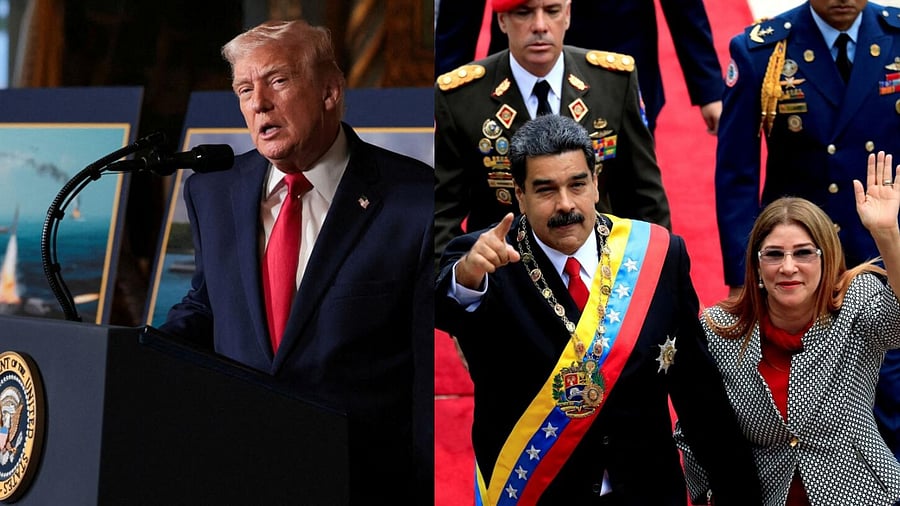
US President Donald Trump and Venezuelan President Nicolás Maduro and his wife.
Credit: Reuters
The United States has launched air strikes inside Venezuela, sharply escalating a month-long confrontation that Washington says is aimed at drug cartels but which Caracas has condemned as outright “military aggression”.
A U.S. official told Reuters that the strikes were under way early on Saturday. Residents in Caracas and other parts of the country reported loud explosions, low-flying aircraft and brief power outages in some neighbourhoods. Venezuela’s government said it rejected the operation and accused Washington of violating its sovereignty.
President Donald Trump said the operation involved a “large-scale strike” by U.S. forces and claimed that Venezuelan President Nicolás Maduro and his wife had been “captured and flown out of the country”, assertions that have not been independently verified. U.S. officials cited by CBS News said the mission to seize Maduro was carried out by the U.S. Army’s Delta Force, an elite special operations unit. Venezuela’s government swiftly denied the claims, and its defence minister vowed to resist any presence of foreign troops on Venezuelan soil, framing the moment as a test of national sovereignty.
The strikes follow a steady U.S. military build-up around Venezuela through late 2025, with warships, aircraft and thousands of troops deployed across the Caribbean. The aircraft carrier USS Gerald R. Ford and numerous other naval assets have been positioned in the region as part of what U.S. officials have described as a “new phase” of operations.
The Trump administration has framed the campaign as part of an armed confrontation with drug cartels, designating Venezuelan groups such as Tren de Aragua as terrorist organisations and repeatedly accusing Maduro’s government of involvement in narcotrafficking — allegations Caracas denies.
In recent weeks, U.S. forces have launched deadly strikes on more than 30 vessels Washington says were carrying drugs, hit what Trump described as “the dock area where they load the boats up with drugs”, and intercepted convoys operating off Venezuela’s coast. The U.S. Coast Guard has reported fatalities in some operations and has, in certain cases, suspended searches for survivors.
Military action has been accompanied by a tightening economic squeeze. Washington has seized multiple oil tankers carrying Venezuelan crude, ordered what it called a “blockade” of sanctioned vessels entering and leaving the country, and imposed additional sanctions targeting oil trade, alleged weapons links and family members and associates of Maduro. The measures have deepened a long-running crisis in Venezuela’s oil-dependent economy but have not dislodged the president, who has remained in power since 2013.
Despite mounting pressure, Maduro’s government has sought to project control at home. Authorities have recently freed dozens of prisoners detained after post-election protests, a limited concession amid the escalating standoff.
Trump has offered few details about Washington’s endgame. On Christmas Eve, he declined to spell out U.S. objectives but warned that if Maduro “plays tough, it’ll be the last time he’ll ever be able to play tough”, signalling a willingness to escalate further.
As the aerial campaign continues and claims surrounding Maduro’s fate remain unverified, governments across the region are watching closely, amid fears that a widening U.S.–Venezuela confrontation could spill beyond the country’s borders and destabilise a broader swathe of Latin America.