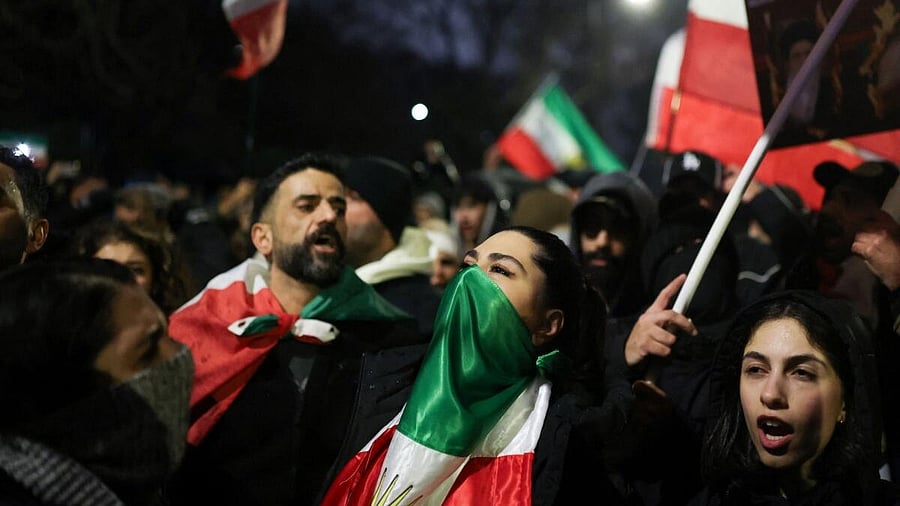
Protests in Iran.
Credit: Reuters
Anti-government protests in Iran grew in size and violence in the past few days as security forces cracked down on demonstrations that began over economic woes two weeks ago and have broadened into a mass movement challenging Iran's authoritarian clerical rulers.
As of Sunday, some human rights monitors said that nearly 200 people, and possibly many more, had been killed since the protests began in late December. The number, a spike over estimates in recent days, suggests the increasingly violent nature of confrontations between protesters and security forces. But restrictions on the internet and international communications have made independent assessments difficult, human rights groups have said.
The government has acknowledged the economic difficulties, but it has at the same time cracked down on demonstrators and sought to blame external forces for fomenting unrest. Iran's president, in an interview with state television Saturday, promised to address economic grievances but warned that the state also had a "duty" not to allow the country to be destabilized.
Authorities have threatened to impose tough measures against protesters and to retaliate if there is international interference. Iran's supreme leader, Ayatollah Ali Khamenei, said Friday that the government would "not back down" and called the protesters vandals who were trying to "please" President Donald Trump.
Trump has pledged that the United States would come to the aid of protesters if the government used lethal force against them, and said he was considering possible options. "Iran is looking at FREEDOM, perhaps like never before," Trump wrote on social media Saturday. "The USA stands ready to help!!!"
Why are Iranians protesting?
Iran's economy has been under sustained pressure for years, largely as a result of U.S. and European sanctions tied to its nuclear ambitions. A 12-day war with Israel in June, which the United States joined to bomb Iranian nuclear facilities, further drained the country's financial resources.
When the currency plunged against the U.S. dollar in late December, amid persistently high inflation, merchants and university students staged days of protests.
But as the rallies grew, the protests became a broader criticism of the rule of Iran's theocratic government. Across social media and television, protesters were seen chanting slogans including, "Death to the dictator" and "Iranians, raise your voice, shout out for your rights."
How intense are these protests?
Demonstrations have spread to dozens of cities across Iran, according to tracking by the U.S.-based Institute for the Study of War.
At least 192 people have been killed in the protests, according to Iran Human Rights, a nonprofit monitor based in Norway.
On Sunday, HRANA, a U.S.-based Iranian human rights monitor, reported that there have been protests in about 585 locations in more than 185 cities across all 31 provinces of the country, with more than 10,000 people arrested so far. The group said that nearly 500 protesters and almost 50 security personnel have been killed in the unrest.
On Friday, videos posted on BBC Persian television showed thousands of people marching in Tehran, drawing supporters from what residents said in interviews was a cross-section of working-class, middle-class and wealthy neighborhoods.
Videos verified by The New York Times showed armed men firing weapons along empty streets in two Iranian cities Friday and Saturday, in an apparent effort to intimidate residents and would-be protesters.
Iran's chief of police, Brig. Gen. Ahmadreza Radan, said the deaths and injuries were the fault of "unpaid soldiers of Iran's enemies," including the United States and Israel, saying that actions "were not carried out by security forces, but by trained and directed elements."
Amir Reza, 42, an engineer, said in an interview from Tehran on Friday that he could hear gunfire and had decided to go home after riot police officers and militias in plainclothes began firing in the air and chasing crowds to disperse them.
A video Friday verified by the Times showed at least seven people lying motionless on the floor of Al-Ghadir Hospital in Tehran, apparently dead.
How has Iran's government responded?
The government initially signaled a willingness to listen to protesters' demands. Earlier this month, it announced plans to provide most citizens with a monthly payment equivalent to around $7.
President Masoud Pezeshkian has acknowledged what he called the public's "legitimate" grievances. He quickly appointed a new head of the central bank and urged against "any violent and coercive behavior."
Yet Iranian officials have hardened their stance in recent days, an echo of previous rounds of unrest when authorities used mass arrests and violence to suppress demonstrations.
Mohammad Movahedi Azad, Iran's prosecutor general, warned Saturday in comments carried by Iranian state media that legal proceedings against rioters should be "without leniency, mercy or appeasement." He warned that "all criminals involved" would be considered an "enemy of God," a capital offense.
The Iranian government has now called for a three-day period of national mourning for those killed by "urban terrorist criminals" -- presumably referring to security forces killed in the confrontations -- according to the semiofficial news agency, Tasnim.
"The president of Iran, expressing deep sorrow over the loss of the country's beloved sons," Tasnim wrote, calling on the population to join a "National Resistance March" on Monday.
What has been the international reaction?
Iran's government is weakened on the international stage and dealing with the gnawing fear of another round of U.S. or Israeli military strikes. Threats from Trump have been especially resonant in light of the U.S. capture of Venezuela's president, Nicolás Maduro, earlier this month.
Trump has said that the United States is "locked and loaded and ready to go" if the Iranian government used lethal force against demonstrators, and he has been briefed on potential military strikes, according to U.S. officials familiar with the matter, but as of Sunday, Trump had not said publicly if he'd made a final decision on whether to follow through on his threat.
Democratic and Republican lawmakers Sunday expressed wariness about American interference in Iran, however.
Iranian officials said that they would react forcefully to an intervention. "If the United States takes military action, both the occupied territories and U.S. military and shipping lanes will be our legitimate targets," Mohammed Ghalibaf, Iran's speaker of parliament, said in a statement Sunday, according to Tasnim. Both U.S. and Israeli military bases could be targets, he said.
Prime Minister Benjamin Netanyahu of Israel said Sunday that Israel was "closely monitoring" the protests and expressed support for the demonstrators. Israel's army said it was "prepared defensively" for any attack.
The unrest has also brought some attention back to Reza Pahlavi, the son of the deposed Shah of Iran, who lives in exile in the United States. In a video Saturday, he urged Iranians to attend evening protests over the weekend and called on workers in key sectors like oil and gas to go on strike.
Footage from Friday that was verified by the Times showed a crowd of demonstrators gathered in Punak, Tehran, chanting: "This is the final battle. Pahlavi will return." But some experts question the extent of support for Pahlavi in Iran.