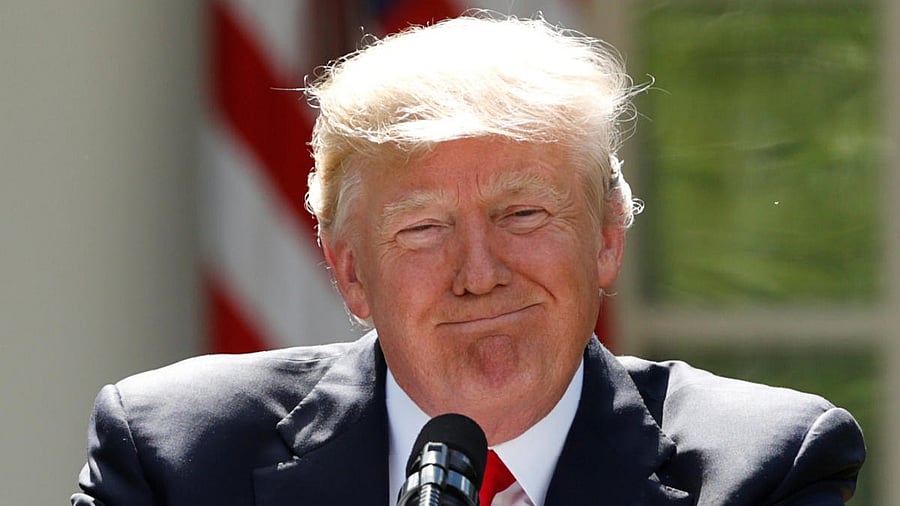
US President Donald Trump
Credit: Reuters Photo
President Donald Trump's return to the White House in 2025 kicked off a frenetic year for global trade, with waves of tariffs on US trading partners that lifted import taxes to their highest since the Great Depression, roiled financial markets and sparked rounds of negotiations over trade and investment deals.
His trade policies - and the global reaction to them - will remain front and center in 2026, but face some hefty challenges.
What happened in 2025
Trump's moves, aimed broadly at reviving a declining manufacturing base, lifted the average tariff rate to nearly 17 per cent from less than 3 per cent at the end of 2024, according to Yale Budget Lab, and the levies are now generating roughly 30 billion dollars a month of revenue for the US Treasury.
They brought world leaders scrambling to Washington seeking deals for lower rates, often in return for pledges of billions of dollars in US investments.
Framework deals were struck with a host of major trading partners, including the European Union, the United Kingdom, Switzerland, Japan, South Korea, Vietnam and others, but notably a final agreement with China remains on the undone list despite multiple rounds of talks and a face-to-face meeting between Trump and Chinese leader Xi Jinping.
The EU was criticized by many for its deal for a 15 per cent tariff on its exports and a vague commitment to big US investments. France's prime minister at the time, Francois Bayrou, called it an act of submission and a "sombre day" for the bloc. Others shrugged that it was the "least bad" deal on offer.
Since then, European exporters and economies have broadly coped with the new tariff rate, thanks to various exemptions and their ability to find markets elsewhere. French bank Societe Generale estimated the total direct impact of the tariffs was equivalent to just 0.37 per cent of the region's GDP.
Meanwhile, China's trade surplus defied Trump's tariffs to surpass 1 trillion dollars as it succeeded in diversifying away from the US, moved its manufacturing sector up the value chain, and used the leverage it has gained in rare earth minerals - crucial inputs into the West's security scaffolding - to push back against pressure from the US or Europe to curb its surplus.
What notably did not happen was the economic calamity and high inflation that legions of economists predicted would unfold from Trump's tariffs.
The US economy suffered a modest contraction in the first quarter amid a scramble to import goods before tariffs took effect, but quickly rebounded and continues to grow at an above-trend pace thanks to a massive artificial intelligence investment boom and resilient consumer spending. The International Monetary Fund, in fact, twice lifted its global growth outlook in the months following Trump's "Liberation Day" tariffs announcement in April as uncertainty ebbed and deals were struck to reduce the originally announced rates.
And while US inflation remains somewhat elevated in part because of tariffs, economists and policymakers now expect the effects to be more mild and short-lived than feared, with cost sharing of the import taxes occurring across the supply chain among producers, importers, retailers and consumers.
What to look for in 2026 and why it matters
A big unknown for 2026 is whether many of Trump's tariffs are allowed to stand. A challenge to the novel legal premise for what he branded as "reciprocal" tariffs on goods from individual countries and for levies imposed on China, Canada and Mexico tied to the flow of fentanyl into the US was argued before the US Supreme Court in late 2025, and a decision is expected in early 2026.
The Trump administration insists it can shift to other, more-established legal authorities to keep tariffs in place should it lose. But those are more cumbersome and often limited in scope, so a loss at the high court for the administration might prompt renegotiations of the deals struck so far or usher in a new era of uncertainty about where the tariffs will end up.
Arguably just as important for Europe is what is happening with its trading relationship with China, for years a reliable destination for its exporters. The depreciation of the yuan and the gradual move up the value chain for Chinese companies have helped China's exporters. Europe's companies meanwhile have struggled to make further inroads into the slowing domestic Chinese market. One of the key questions for 2026 is whether Europe finally uses tariffs or other measures to address what some of its officials are starting to call the "imbalances" in the China-EU trading ties.
Efforts to finally cement a US-China deal loom large as well. A shaky detente reached in this year's talks will expire in the second half of 2026, and Trump and Xi are tentatively set to meet twice over the course of the year.
And lastly, the free trade deal with the two largest US trading partners - Canada and Mexico - is up for review in 2026 amid uncertainty over whether Trump will let the pact expire or try to retool it more to his liking.