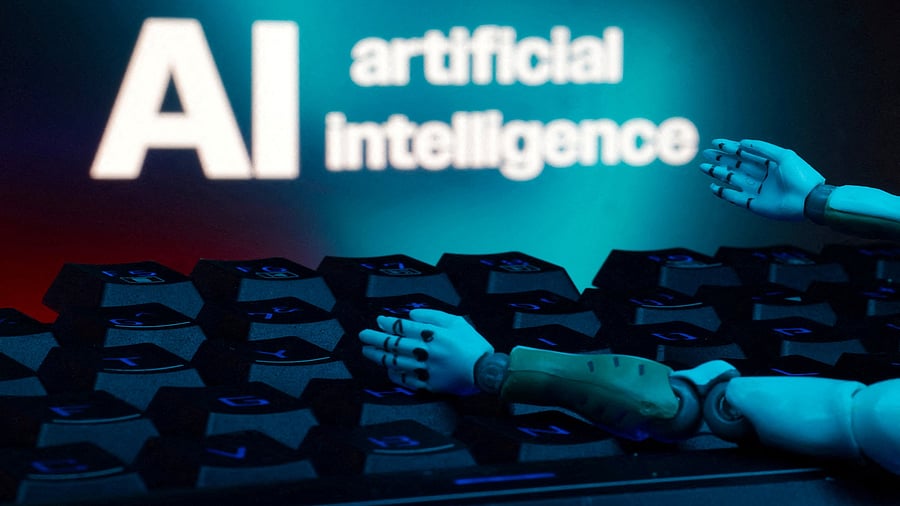
File photo for representational purpose.
Credit: Reuters Photo
Bengaluru: Big tech giants are now investing heavily in Artificial Intelligence and new tools that could enhance their businesses. From Google, Microsoft, to Amazon and Oracle, everyone has increased their AI spending to expand their AI capabilities. Analysts noted signs of intensifying competition as companies aim to advance their AI offerings.
Google parent Alphabet recently announced that its capex spend this year will be more than double its 2025 capex spend. "Overall, we’re seeing our AI investments and infrastructure drive revenue and growth across the board. To meet customer demand and capitalise on the growing opportunities ahead of us, our 2026 CapEx investments are anticipated to be in the range of 175 to 185 billion dollars," Sundar Pichai, CEO of Google and Alphabet, said during the company's Q4 earnings call.
According to Goldman Sachs, AI companies may invest over 500 billion dollars in 2026. According to reports, both Amazon and OpenAI are engaging in discussions for a possible collaboration and that the former is reportedly in talks to invest up to 50 billion dollars in the latter. Big tech giants are also collaborating or investing in AI companies such as Perplexity, Anthropic and OpenAI.
Indian IT services companies are upskilling their workforce to be AI-ready and are also collaborating with tech giants to win large deals. Last month, Infosys announced a collaboration with Cognition to accelerate the AI value journey for global enterprises. Nasdaq-listed Cognizant has adopted Anthropic's Claude to help its enterprise customers and internal teams move from AI experimentation to scaled business outcomes.
AI models and tools continue to drive exponential innovation and rapid adoption. The recently released Claude Cowork tool aims to automate work across functions such as legal, sales, marketing, and data analysis.
However, concerns that such tools will significantly disrupt or eliminate the technology services sector, where India has a strong global presence, are misplaced, industry body Nasscom said.
"Indian technology services companies work closely with global enterprises that operate complex technology environments, with interconnected systems and fragmented data. Creating real business value from AI requires careful coordination, with humans in the loop who understand business context, industry knowledge, and enterprise workflows," it added.
AI is unlikely to be adopted as a simple “out-of-the-box” solution in large enterprises. Technology services companies have already accelerated their data and AI capabilities by investing in platforms, building partnerships with AI companies and hyperscalers, upskilling talent, and leveraging mergers and acquisitions.
With AI, new opportunities are emerging in areas such as legacy modernisation, AI-ready data foundations, and the use of intelligent agents across business and enterprise functions.
As enterprise AI adoption moves from experimentation to large-scale deployment, technology services companies will play a critical role in enabling this transition, Nasscom explained.
Kanishk Agrawal, Chief Technology Officer at Judge Group India, said AI investment is more critical than ever. Indian IT companies must shift from their legacy outsourcing model to that of an AI-native solution provider by embedding generative and agentic AI into their core service offerings, co-creating industry-specific platforms with their clients and creating measurable business outcomes for them as well.
"By building on their internal AI expertise with continuing education, establishing MLOps (Machine Learning Operations) practices and improving data governance, Indian IT companies will transform themselves from vendors to strategic partners. AI is quickly transforming workflows and enterprise value chains, and for Indian IT Services to remain relevant, provide growth and lead the global digital transformation, they must increase their AI investment not just on technology spend, but also in talent, delivery models and in their overall mindset," Agrawal said.
The focus is no longer on increasing AI spend alone, but on making AI work reliably at scale, Anurag Jain, CEO & Co-founder ORISERVE said.
The next phase of growth will come from moving beyond implementation support to owning AI-led outcomes. This requires building strong domain depth, especially in regulated and complex industries, and delivering production-ready AI systems that can operate under real-world constraints, Jain added.