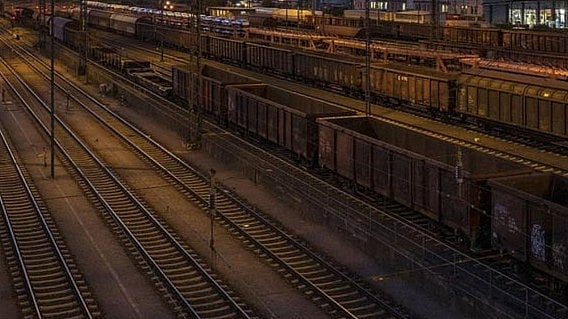
Fil photo for representational purpose.
Credit: X/@RailAnalysis
Kolkata: With West Bengal bracing for a fiercely contested assembly election in the coming months, the Union Budget presented on Sunday has unmistakably slipped into campaign territory, rolling out high-visibility infrastructure proposals even as the ruling TMC accused the Centre of using development announcements as a political signalling tool rather than a genuine fiscal commitment.
Finance Minister Nirmala Sitharaman's ninth consecutive budget proposed a new dedicated freight corridor linking Dankuni in West Bengal to Surat in Gujarat, an integrated East Coast Industrial Corridor with a major node at Durgapur, and tourism-focused interventions under the Centre's Purvodaya vision, measures that the BJP sees as reinforcing its narrative of development-led politics in eastern India ahead of the polls.
The Dankuni–Surat freight corridor, pitched as a move to promote environmentally sustainable cargo movement and reduce logistics costs, has emerged as the budget’s most politically salient promise for Bengal.
The Centre has argued that shifting freight towards inland water transport and integrated corridors would unlock industrial growth in the state, long portrayed by the BJP as having suffered from policy stagnation under the Trinamool Congress.
The budget also proposed the creation of tourism destinations across five Purvodaya states and provisions for 4,000 e-buses, announcements that the BJP believes can be leveraged in a state where employment, urban mobility and regional imbalance have become major electoral talking points.
The timing, however, has not gone unnoticed.
In recent years, Union Budgets preceding Assembly elections have often carried pronounced regional emphasis.
Bihar, which went to the polls in 2025, saw a succession of big-ticket announcements in the preceding budgets, from airport expansion to irrigation and industrial projects, a pattern that critics said reflected political timing as much as developmental need.
That precedent has shaped expectations in Bengal this year.
While the Centre has stopped short of announcing a special financial package for West Bengal, the infrastructure-heavy focus has been read as an attempt to sketch a pre-election development roadmap, particularly as the BJP intensifies its campaign to dislodge the Mamata Banerjee-led government after over 15 years in power.
The political undertones were amplified by the sharp response from the Trinamool Congress, which framed the budget as further evidence of what it calls discriminatory Centre–state relations.
The TMC accused the Centre of dressing up old decisions as fresh sops. TMC national general secretary and MP Abhishek Banerjee accused the BJP of combining "headline announcements with fiscal denial".
"For the last five years, we have been saying this. If the Centre can show, by releasing a white paper, that even one MGNREGA job-card holder in Bengal received money through Direct Benefit Transfer after the BJP's defeat in the 2021 Assembly elections, I will quit politics," he said.
He alleged that funds under flagship central schemes such as PM Awas Yojana and Gramin Sadak Yojana have remained blocked since the last polls, arguing that infrastructure announcements in the budget could not mask what he described as sustained financial deprivation.
"In Bengal, they are losing. That is why the BJP is trying to teach the people a lesson. But democracy works the other way round," Banerjee said, asserting that voters would respond at the ballot box.
TMC state vice-president Jaiprakash Majumdar dismissed the proposals as "old policy decisions wrapped in a new packet", questioning whether the announcements would translate into actual spending before the election.
"The budget has focused on Bengal's infrastructure development, which will boost the state's economy," BJP leader Rahul Sinha said, arguing that connectivity and industrial projects would create jobs and attract investment, particularly in regions such as north and western Bengal.
The debate over north Bengal has itself become a prominent campaign theme. A day before the budget, Union Home Minister Amit Shah accused the Trinamool government of systematically under-allocating resources to the region, a charge that the BJP is using to court voters in districts it sees as electorally pivotal.
Political analysts say the budget's Bengal focus must be read in conjunction with the BJP's broader electoral strategy, which includes ambitious vote-share targets and repeated attacks on the state government over corruption, welfare delivery and law and order.
"Budget allocations are not made in a political vacuum," said an economist, noting that when major states approach Assembly elections, fiscal decisions attract heightened political scrutiny.
"In a federal system, the Union budget becomes a powerful instrument — shaping not just economic outcomes but also political narratives around fairness, accountability and responsiveness," he said.
Another political analyst said that election-bound states often receive enhanced Budget attention as part of democratic signalling. "Infrastructure projects and welfare announcements are tangible markers of intent. Voters then assess whether these promises are credible or merely symbolic," he said.
The budget has embedded economic policy, development claims and Centre–state relations firmly into Bengal's poll battle, underscoring that in an election year, it is as much a political document as an economic one.