
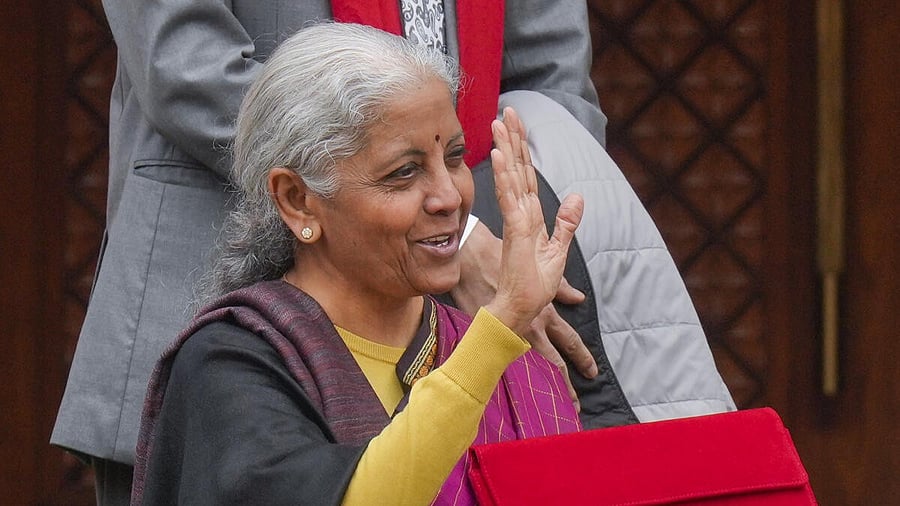
Finance Minister Nirmala Sitharaman shows the digital tablet, enclosed in a traditional red 'bahi-khata' style pouch, at the Parliament premises before the presentation of the ‘Union Budget 2026-27’, in New Delhi, Sunday, Feb. 1, 2026.
Credit: PTI Photo
New Delhi: Finance Minister Nirmala Sitharaman on Sunday announced an exemption of basic customs duty in the Union Budget on components required for the manufacture of civilian, training and other aircraft as well as raw materials imported for manufacture of parts of aircraft to be used in maintenance, repair, or overhaul requirements by defence sector.
These exemptions are part of the tax reforms unveiled by the Finance Minister to boost the manufacturing sector in the country and are being made effective from Monday.
The announcement comes days after the Adani Group and Brazilian multinational aerospace corporation Embraer announced a strategic partnership to set up a regional aircraft manufacturing facility in India, besides collaborating on opportunities in supply chain, aftermarket services and pilot training.
"I propose to exempt basic customs duty on components and parts required for the manufacture of civilian, training and other aircraft. It is proposed to exempt basic customs duty on raw materials imported for manufacture of parts of aircraft to be used in maintenance, repair, or overhaul requirements by units in the defence sector," Sitharaman said.
On the manufacturing of civilian, training and other aircrafts, the budget documents showed that the exemption is being given to components or parts, including engines of aircraft, for the manufacture of aircraft and parts thereof, provided that the importer adheres to the procedure set out in the Customs (Import of Goods at Concessional Rate of Duty or for Specified End Use) Rules, 2022 (IGCRS Rules 2022).
On the exemptions given to the defence sector, it said it is for raw materials for manufacture of parts of aircraft for maintenance, repair, or overhauling of aircraft or components or parts of aircraft, including engines, provided that the goods are imported by Public Sector Units under the Ministry of Defence.
"This exemption is subject to following the procedure set out in the IGCRS Rules 2022. Further, the importer has to produce an end-use certificate from an officer not below the rank of Joint Secretary in the Ministry of Defence," it said.
ICRA Ltd Senior Vice President and Co-Group Head (Corporate Ratings) Kinjal Shah said the BCD exemption on components and parts used in the manufacture of civilian, training, and other aircraft will help lower the aircraft purchase cost for the airlines.
The documents also showed that the allocation for the Ministry of Civil Aviation saw a decline of 12.4 per cent to Rs 2,102.87 crore from the previous budget estimates at Rs 2,400.31 crore. However, compared to the revised budget of Rs 2,055.49 crore for 2025-26, the allocation for 2026-27 has risen.
The Regional Connectivity Scheme or the UDAN has seen an increase in allocation from Rs 540 crore in 2025-26 budget to Rs 550 crore. In the revised budget, it was Rs 434.50 crore. The Air India Asst Holding Ltd has been allocated Rs 758.39 crore.
Air India Express Managing Director Aloke Singh said the budget’s focus on strengthening medical value tourism and destination development is particularly relevant for aviation, as it creates high-frequency, purpose-driven inbound travel, especially from regions such as the Middle East and Southeast Asia.
"At the same time, the emphasis on developing heritage, archaeological, and eco-tourism destinations across multiple states will stimulate demand for air connectivity to Tier-2 and Tier-3 cities, supporting the next phase of domestic aviation growth," he said.