
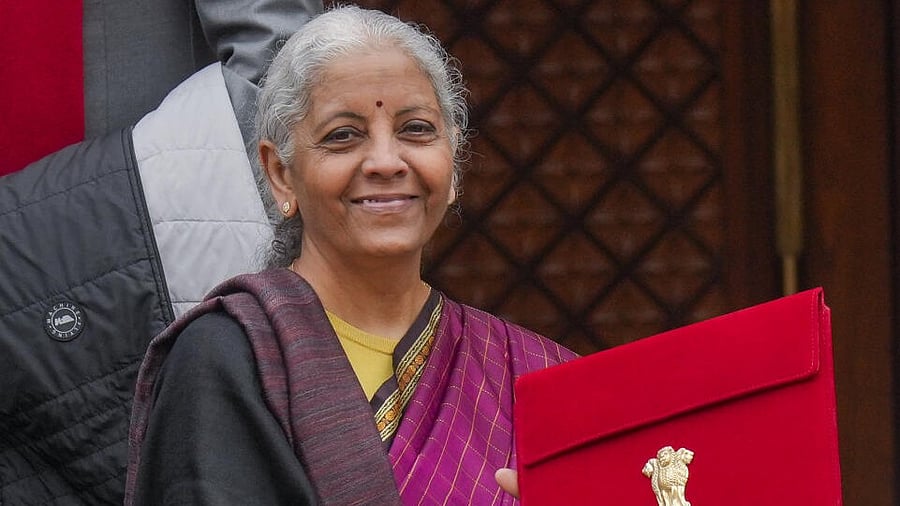
Finance Minister Nirmala Sitharaman.
Credit: PTI Photo
Finance Minister Nirmala Sitharaman on Sunday said that the Union Budget 2026 is based on three 'Kartavyas' or duties.
These 'Kartavyas' include: 1. Accelerating and sustaining economic growth by enhancing productivity and competitiveness.
2. The second is to fulfil the aspirations of the people of the country, while the third will be aligned with the Centre's vision of 'Sabka Sath, Sabka Vikas' philosophy to ensure that every family and sector has access to resources and opportunities for meaningful participation.
3. The third Kartavya, aligned with the government’s vision of Sabka Saath, Sabka Vikaas, aims to ensure inclusive access to growth opportunities. “It is to ensure that every family, community, region and sector has access to resources, amenities and opportunities for meaningful participation,” she said.
For the first 'Kartavya', several schemes in the manufacturing industry have been proposed to be upgraded, in addition to new schemes for the sector.
"Under our first kartavya, I propose interventions in six areas, including Scaling up manufacturing in seven strategic and frontier sectors, rejuvenating legacy industrial sectors, creating champion MSMEs, delivering a powerful push for infrastructure, ensuring long term security and stability and developing city economic regions.
As many as seven sectors will be given priority under the 2026 Budget, including, semiconductors, rare-earth minerals, construction infrastructural equipment, container industry, bio-pharma, textile, and sports equipment.
She said this step is aimed at strengthening India's manufacturing capabilities and enhancing its position in critical sectors of the economy.
The second proposed intervention focuses on rejuvenating legacy industrial sectors. Sitharaman said reviving and strengthening traditional industries remains important for sustaining growth, preserving jobs, and supporting regions that are dependent on these sectors.
The third area of intervention is the creation of champion micro, small and medium enterprises (MSMEs).
The fourth is a focus on strong push for infrastructure Sitharaman said infrastructure development remains a key pillar for economic expansion, supporting both short-term activity and long-term productivity.
The fifth area focuses on ensuring long-term security and stability. The Finance Minister said maintaining stability is crucial for sustaining growth and building confidence across the economy.
The sixth and final area of intervention proposed is the development of city economic regions. Sitharaman said these regions will play an important role in driving economic activity and supporting growth across urban centres.
The Finance Minister said these six interventions together reflect the government's commitment to fulfilling its Kartavya and maintaining the momentum of reforms.
(With inputs from ANI)