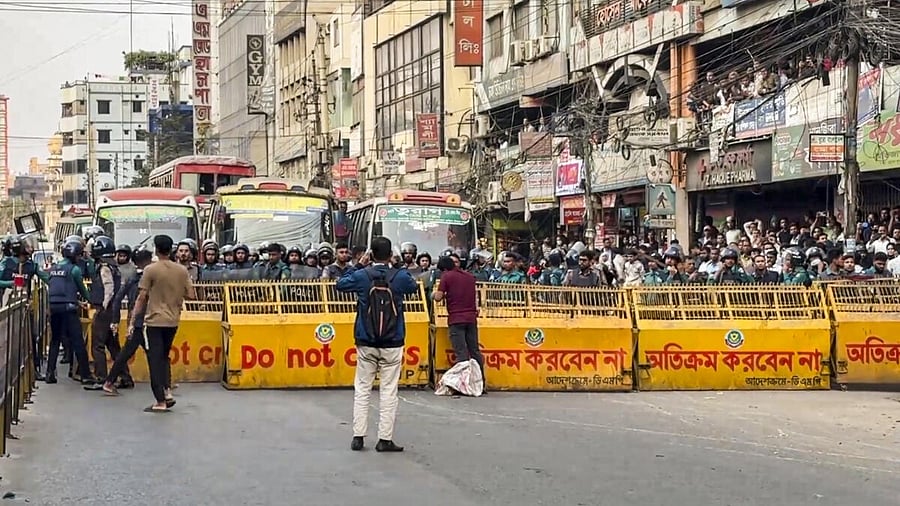
The crisis is, therefore, systemic rather than episodic, rooted in the steady narrowing of political space, and weakening of democratic accountability over the years.
Credit: PTI Photo
Bangladesh is passing through one of the most turbulent phases since the end of military rule in 1990, with the current unrest reflecting not a single trigger, but a convergence of structural decay, political miscalculations, and radical social mobilisation.
What is unfolding on the streets now is the cumulative outcome of prolonged centralisation of power, erosion of democratic safeguards, economic stress among the youth, and the collapse of institutional credibility. The crisis is, therefore, systemic rather than episodic, rooted in the steady narrowing of political space, and weakening of democratic accountability over the years.
The immediate spark may lie in violent street confrontations, but the underlying fire has been smouldering for a long time, fed by the absence of credible mediating institutions capable of absorbing dissent. The interim advisory dispensation bears significant responsibility for this drift, having failed to establish authority, reassure the public or curb escalating violence. Instead of acting as a stabilising bridge between regimes, it has appeared reactive, indecisive, and disconnected, allowing disorder to spread rather than containing it. This vacuum of authority has accelerated public disillusionment and emboldened disruptive forces.
Breakdown of State control
A critical factor in the current turmoil is the mobilisation of radicalised youth groups, some driven by genuine economic frustration, and others by ideological extremism. Extremist organisations, both religious and ultra-nationalist, have exploited this vacuum.
What distinguishes the current unrest from earlier protest cycles is the decentralised nature of violence, with loosely connected groups operating autonomously, and often without identifiable leadership. This fragmentation has rendered conventional law enforcement responses ineffective and reactive. The authorities underestimated the scale of this threat, relying on outdated policing methods while failing to counter online radicalisation or information warfare. As the State writ weakened, non-State actors stepped in, creating zones of parallel authority and fear, further eroding public confidence in governance and security institutions.
Regional fallout
The implications of Bangladesh’s turmoil extend well beyond its borders. For India, instability next door is never a distant problem. Prolonged unrest raises the spectre of refugee flows into eastern states of West Bengal, Assam and Tripura, straining social cohesion and administrative capacity. Radical groups operating in Bangladesh have historically maintained linkages with networks in India’s Northeast, and renewed instability could revive dormant insurgent corridors that were dismantled through years of security co-operation.
Pakistan, though geographically separated, may view the chaos as an opportunity to regain strategic relevance in South Asia by encouraging narratives hostile to India or exploiting Islamist sentiment. More broadly, instability threatens regional connectivity initiatives, cross-border trade, energy co-operation and Bay of Bengal maritime security, undermining economic integration in eastern South Asia at a time of heightened geopolitical competition.
India’s strategic test
For India-Bangladesh ties, the crisis represents a severe stress test. Over the past decade, bilateral ties have rested on security co-operation, economic integration, and political trust between the leaderships. Sustained instability threatens all three pillars simultaneously. India cannot afford a posture of indifference, yet overt intervention would be counterproductive, reinforcing nationalist backlash within Bangladesh.
New Delhi’s response must, therefore, be calibrated, combining quiet diplomatic engagement with humanitarian readiness and firm advocacy for institutional restoration. India should work through regional and multilateral forums to press for de-escalation, protection of minorities, and a credible roadmap to political normalcy.
The dilemma, a trap
The Bangladesh army’s role has become central yet ambiguous. Historically, the ultimate guarantor of order, it now appears reluctant to assume full control, wary of domestic backlash and international scrutiny, yet unwilling to allow total breakdown. This hesitation has produced an unstable equilibrium, preventing collapse but prolonging uncertainty, and fuelling speculation about eventual intervention. In such a climate, the prospect of free and credible elections appears increasingly remote. Polls held amid pervasive violence and administrative paralysis risk producing contested outcomes, and deeper instability rather than legitimacy.
Limits of external pressure
The United States’ reaction is being closely watched. Washington’s perceived role in the ouster of former president Sheikh Hasina has entered popular discourse, fuelling suspicions of external engineering. The US is likely to publicly emphasise democracy, human rights, and inclusive elections, while privately prioritising stability and counter-extremism. Its leverage, however, remains constrained; excessive pressure could aggravate chaos rather than resolve it, while sanctions could further weaken an already fragile economy.
Crossroads with regional consequences
Ultimately, Bangladesh stands at a crossroads where postponing hard decisions will only compound the crisis. Restoring order requires reassertion of State authority, dismantling extremist networks, and rebuilding trust through inclusive political dialogue. The Bangladesh army must decide whether it will merely manage instability or actively facilitate a civilian-led transition. For India and the region, the priority must be preventing spillover while supporting a sovereign, stable, and democratic Bangladesh.
K S Tomar is a Shimla-based senior political analyst. X: @Toruhp.
Disclaimer: The views expressed above are the author's own. They do not necessarily reflect the views of DH.