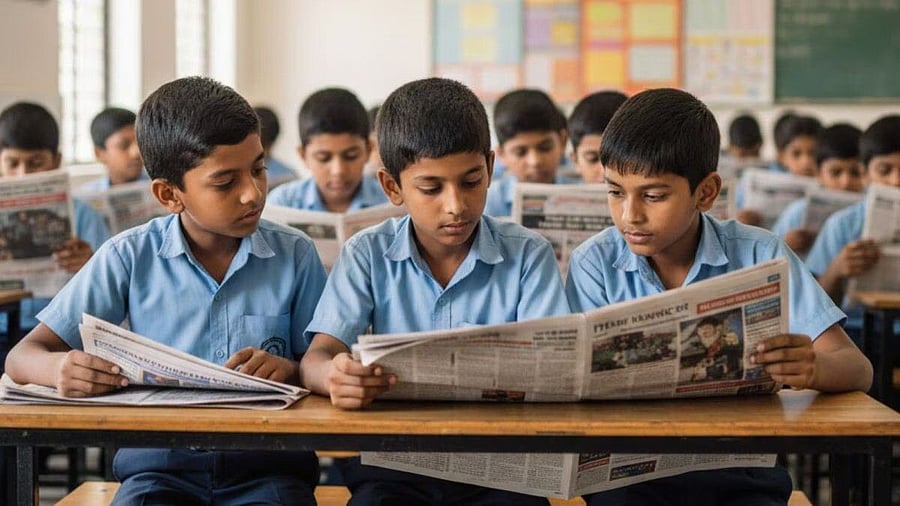
Image for representational purpose.
Credit: X/@IndianTechGuide
A generation that cannot read deeply, cannot think independently. When a population’s ability to read weakens, its capacity to judge evidence and resist manipulation withers too.
This is precisely why the Government of Uttar Pradesh and Rajasthan now requires mandatory 10 minutes of newspaper reading in each government school. The policy is a targeted attempt to convert casual exposure into disciplined practice.
The move treats reading as a foundational civic skill — the smallest repeatable act intended to rebuild the attention and critical thinking of all school-going children.
Why should literacy be treated as a security issue? The blunt answer is that basic reading and comprehension are the first line of defence against misinformation campaigns.
United Kingdom’s Education Secretary Bridget Phillipson recently warned about plummeting reading habits, which risks leaving young people exposed to foreign disinformation — a reminder that national defence begins in the classroom.
The scale of decline is worrying.
Recent national surveys show a drop in enjoyment and daily reading among children, with far fewer young people picking up long-form texts in their free time. The National Literacy Trust’s 2024 findings show sharp falls in the reading-for-pleasure and daily reading, trends which correlate with poorer comprehension and reduced capacity for sustained attention. These are not abstract harms, they are measurable losses in the mental tool; citizens use to parse news, weigh evidence, and hold institutions to account.
Across both Uttar Pradesh and Rajasthan, the 10-minute mandate has been inserted into the school day — usually as part of morning assembly or language period, to rebuild stamina, widen vocabulary, and reconnect pupils to current affairs. Yet the policy’s promise depends on more than just the clocked minutes: teacher facilitation, access to diverse and age-appropriate newspapers, and short follow-up activities that teach source-checking and comprehension are essential.
In other words, the measure is a pragmatic, low-cost nudge towards civic reading habits, useful only if paired with curriculum support, basic resources, and modest teacher training that turns passive skimming into active, critical engagement.
How exactly does weak reading translate into security risk? Disinformation succeeds when people fall prey to headlines and images rather than arguments; when the context is skimmed away, emotional triggers do the work.
Deep reading teaches readers to interrogate tone, detect bias, follow chains of evidence, and hold competing narratives in mind. Without these habits, populations become a fertile ground for extremist narratives, targeted micro-propaganda, and AI-generated falsehoods that exploit superficial attention rather than substantive debate. The line from poor literacy to increased susceptibility is short and well-trodden.
Policy responses should be practical, but principled. Mandates like Uttar Pradesh and Rajasthan — a 10-minute ‘news slot’ with editorial discussion, vocabulary work, and reflection tasks — can create repetitive practice that turns reading into a habit.
But mandates alone are not enough. They should be paired with a national resilience framing: investment in school libraries, teacher training in critical reading, and public campaigns that celebrate reading for pleasure as civic work. The UK’s call for a task force on reading shows the right instincts: strengthen supply (books, access, instruction) and nurture demand (motivation, pleasure, relevance).
Some can object that we live in a digital age and that ‘digital literacy’ matters more than books. That is a category error. Digital literacy depends on foundational skills of interpretation and argument that deep reading develops.
Skimming feeds speed and short-term reaction; deep reading builds the patience to check, compare, and think through trade-offs. Digital savvy without that foundation is brittle — good at clicking, poor at judging.
Reframing reading as a civic infrastructure — slow to build, costly to repair, and indispensable in a democracy — helps set priorities. Roads and public health demand steady investment because their neglect produces cascading harm; so does the steady erosion of critical reading. If defending our institutions from manipulation matters, then so does returning a page and a pen to the rhythms of childhood.
The defence of democracy may begin not in a war room but at a school assembly, where a child reads an editorial and asks more questions, which lead to informed discussions, and help develop viewpoints. That is the start of resilience.
Policymakers, educators, and parents should stop treating reading as a private pastime, and start treating it as a public good. If we act now — by combining curricular reforms, public campaigns, and modest mandates that cultivate practice — we can rebuild the capacities that keep republics awake, attention, curiosity, and the courage to demand evidence. Otherwise, we risk a generation raised on headlines and hollow certainties — easy prey for those who would bend truth to power.
Jisu Ketan Pattanaik is an assistant professor of sociology, at the National University of Study and Research in Law, Ranchi. X: @JisuDr
Avinash Verma is a research assistant and student, at the National University of Study and Research in Law, Ranchi.
(Disclaimer: The views expressed above are the author's own. They do not necessarily reflect the views of DH.)