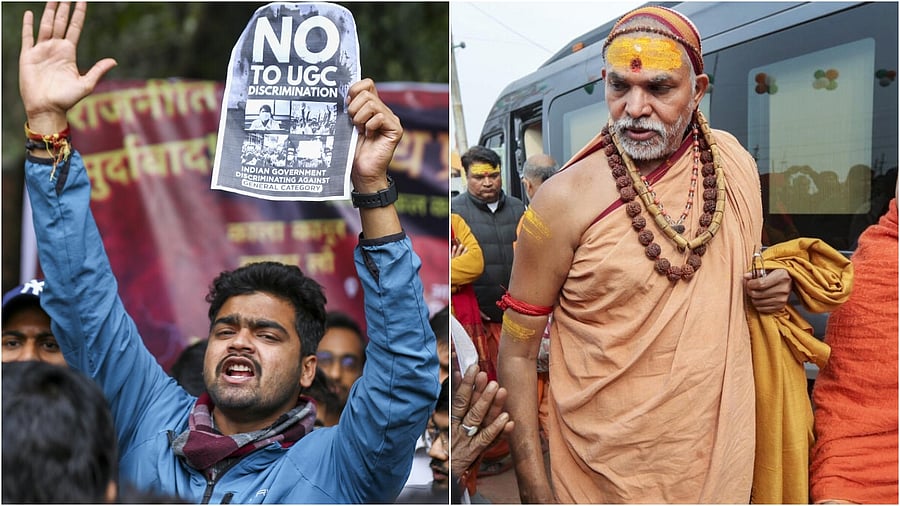
Students protest against the UGC Act (L), Shankaracharya of Joshimath, Avimukteshwaranand Saraswati
Credit: PTI File Photos
The Bharatiya Janata Party (BJP) is experimenting with caste equations in northern India, especially in Uttar Pradesh. The state goes to the polls in early 2027, and is considered a bellwether for the voter behaviour in the cow-belt states. UP also contributes a whopping 80 seats to the Lok Sabha.
The BJP is worried by OBC and SC/ST votes lining up behind the Opposition, which led to the party’s dismal performance in the 2024 general elections. In UP, the BJP’s Lok Sabha tally plummeted from 66 in 2019 to 33 in 2024. Opposition seats went up — the Samajwadi Party went up to 37 seats from five in 2019, and the Congress, to six from five.
Two recent developments may be seen as experiments towards achieving this goal. The new UGC equity guidelines for preventing discrimination against SC/ST and OBC students in universities is one. The administrative imbroglio preventing the Shankaracharya of Joshimath, Avimukteshwaranand Saraswati, from his ritual bath in the Ganga at Prayagraj on the Hindu auspicious day of Mauni Amavasya, is another.
Both have had a complicated fallout. The implementation of the UGC equity guidelines led to protests by upper caste youth, especially in Uttar Pradesh, Bihar, Delhi and Madhya Pradesh. Following these, the guidelines have been held in abeyance by the Supreme Court.
The ‘mistreatment’ of the Shankaracharya has become a political opportunity, leading to deep unease within the BJP in UP, and a politically ambitious civil servant in Bareilly to resign over ‘discrimination’ against upper castes, especially Brahmins.
On the face of it, the UGC equity regulations fine-tune similar regulations of 2012. This was done on the basis of the Supreme Court’s direction to UGC to devise strong anti-discrimination mechanisms in educational institutions in response to public interest litigations filed by the mothers of Rohith Vemula (Dalit/SC) and Payal Tadvi (ST). The petitioners sought stronger measures to safeguard SC/ST students from upper caste discrimination. Both Vemula and Tadvi had committed suicide after facing caste-based harassment.
However, the Supreme Court's intervention was focused on SC/STs. It did not mandate the inclusion of OBCs. The draft regulations made public in February 2025 also did not include OBCs. They were added in the final UGC guidelines.
The addition of OBCs to the UGC equity guidelines was a deliberate choice made by the Narendra Modi government. Since discrimination does exist against OBC students as well, excluding them would have made the regulations seem incomplete. However, it is also true that OBCs form the largest voting bloc in India, and the BJP would like not to be perceived as an upper-caste party. The regulations would increase the equity of the BJP among SC/STs and OBCs.
The confrontation with the Shankaracharya was not limited to preventing him from a ritual bath in the Ganga and beating his followers. He was also sent two notices — one questioning his right to hold the title of ‘Shankaracharya’ and the second, threatening to withdraw the camping land and facilities allocated to him at the Magh Mela at Prayagraj, asking, “Why should you not be permanently banned from the fair?”
Avimukteshwaranand has been critical of the BJP government of Yogi Adityanath in UP — particularly over its responsibility for the stampede deaths in the Kumbh Mela last year. He has not spared even Modi in the past. However, in questioning his status, the State has asserted its authority somewhat aggressively. A Shankaracharya is appointed by the other Shankaracharyas and, especially after the Magh Mela controversy, the three other Shankaracharya’s have stood by Avimukteshwaranand as the legitimate holder of the title. The second notice is an administrative threat, showing the State’s muscle.
In the caste-riven political perceptions of UP, this is being viewed as a tussle between a Rajput chief minister — Yogi Adityanath aka Ajay Singh Bisht — questioning the authority of the Shankaracharya, who is always a Brahmin. Not only the Congress and the Samajwadi Party — but even the Hindu Mahasabha have framed the confrontation with the pontiff as disrespect for sanatan dharma, with an eye on the Brahmin community. Even though the Shankaracharya has left Prayagraj humiliated and insulted, the imbroglio has become a political issue, and risks fracturing the BJP’s upper-caste coalition of Brahmins and Rajputs.
Did the BJP miscalculate or did it want the narrative to turn this way? It must have known that the inclusion of OBCs to the equity guidelines would trigger a backlash from upper-caste students anxious that fake charges of discrimination could potentially ruin their careers. Nevertheless, at the same time the BJP needed to scuttle the Opposition’s slogan ‘Jitni abadi, utna haq’ (rights according to population share) which is an attempt to consolidate OBCs, and SC/STs behind its political platform.
It may have expected either that there would be counter-agitations of OBC/SC/ST students on university campuses or that they would peter away if the Supreme Court hearing the petition to review the guidelines put a pause on their implementation. As expected the apex court has described the guidelines as “vague” and “capable of misuse”.
The Shankaracharya issue will probably send a signal that contrary to popular perception — the BJP is not a party of Brahmins.
The BJP’s experiments have been paused for now. It will be watching how the OBC/ST/STs react. Maybe it will win on both counts with the upper castes claiming victory and staying with the party, while the OBCs and Dalits will be told that while the BJP stands for social justice and equity, it cannot go against the apex court.
The Shankaracharya issue also addresses the non-Brahmin castes. The Rajputs will see Adityanath’s authority intact and unchallenged. Brahmins might be seen as a contested constituency for both the BJP and the Opposition, but the BJP believes that they will have no choice but to go with it. They will not accept the leadership of OBC parties like the Samajwadi Party in UP and the Congress has committed itself too openly to championing the interests of the OBCs and Dalits, for Brahmins to feel comfortable with it. The upper castes have in any case deserted the Congress in the cow-belt states because they do not see it as a viable alternative.
In allowing these experiments to test caste sentiments and loyalties, well in advance of the crucial UP legislative elections, the BJP’s central leadership clearly thinks it can control any social churn they could trigger.
Bharat Bhushan is a New Delhi-based journalist.
(Disclaimer: The views expressed above are the author's own. They do not necessarily reflect the views of DH)