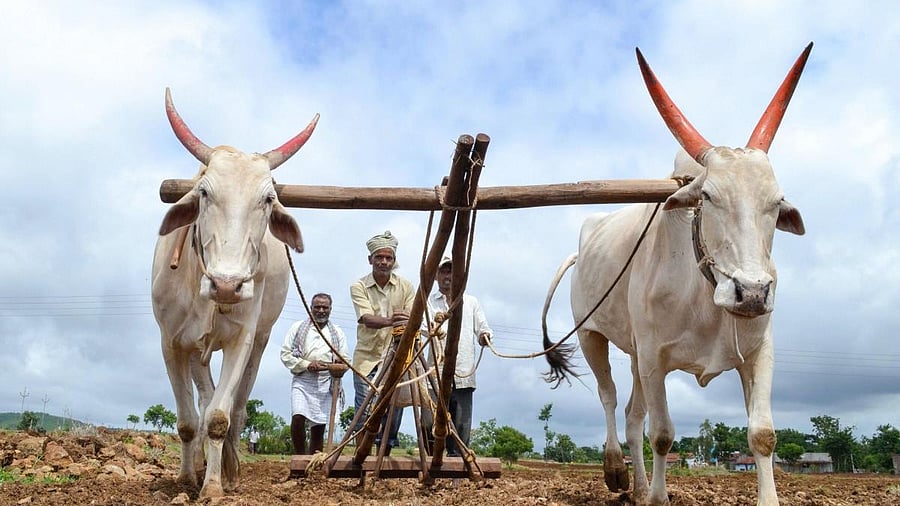
File photo for representational purpose.
Credit: PTI file photo
In line with the emphasis of the regime on duties rather than rights, Union Finance Minister Nirmala Sitharaman highlighted three kartavyas (duties) in relation to the Budget formulation.
The first duty is to accelerate and sustain economic growth, by enhancing productivity and competitiveness, and building resilience to volatile global dynamics. The second duty is to fulfil aspirations and build capacity.
She highlighted that about 25 crore Indians have come out of multidimensional poverty. The third duty is to ensure that every family, community, region, and sector has access to resources, amenities, and opportunities for meaningful participation.
For meeting the third duty, there was a passing reference to efforts for increasing farmer incomes. But there was no reference to the much-discussed and aggressively promoted promise of doubling farmers’ income by 2022-2023. Not too long ago, the entire Narendra Modi government was focused on this laudable objective.
Sitharaman mentioned a few allied sectors of agriculture, like animal husbandry, dairy, and fisheries.
While the Economic Survey highlighted that the decadal growth of 4.45 per cent (FY2016-2025), the major contributors were livestock (7.1 per cent) and the fishing and aquaculture (8.8 per cent) sectors. The crop sector grew by just 3.5 per cent.
So, the integrated development of 500 reservoirs and Amrit Sarovars will be a good initiative for the sector. She also mentioned strengthening the fisheries value chain in coastal areas through fish farmers producer organisations.
Seafood is an important contributor to India’s exports. In 2024-2025, the value of exports was 7.4 billion dollars. Due to the imposition of 50 per cent tariff by the United States, the sector has witnessed diversification of export markets.
So, the investment in the value chain and creation of the highest standard of infrastructure will not only support the livelihood of fish farmers, but it will also add to India’s export earnings.
The livestock sector delivered a compound annual growth rate (CAGR) of 12.77 per cent at current prices between 2015 and 2024. Its Gross Value Added increased by 195 per cent. The minister mentioned that in rural and peri-urban areas, a credit-linked subsidy programme will be supported.
She also mentioned scaling up and modernisation of livestock enterprises. She also mentioned support for the creation of livestock, dairy, and poultry-focused value chains and the establishment of Livestock Farmer Producers Organisations.
Income from the dairy business is not exempt from income tax. As a result, most dairy farmers have only a small number of milch animals. The sector can get a major boost from such an exemption, as that can spur private investment in commercial dairy farms.
Sitharaman also spoke about high-value agriculture, but she did not say much about the horticulture sector. She mentioned coconut, sandalwood, cocoa, and cashew in coastal areas. It could well be inspired by the coming assembly elections in Kerala and Tamil Nadu.
She proposed a coconut production scheme to enhance productivity. We already have a Coconut Development Board and Coir Board. India exported coconut products valued at Rs 3,469.44 crore in 2023-2024, but Indian exports have been facing tough competition from Vietnam in the export market.
The minister also announced promotion of cashew, cocoa, and sandalwood production so as to make India self-reliant, and make Indian products into a premium global brand by 2030.
Support for sandalwood, walnuts, almonds, and pine nuts may help in enhancing farmers growing these crops. This promotion must be seen in light of the increase in the consumption of nuts, with imports in 2024-2025 being about 1.68 billion dollars for cashew nuts alone. Imports of walnuts have also been increasing.
The Budget speech did not say much about the crop sector, which has the largest area under cultivation. One expected some intervention to increase the cultivation of protein crops, as protein deficiency is affecting a large population.
Siraj Hussain is former Agriculture Secretary to the Government of India. X: @sirajnoida
Disclaimer: The views expressed above are the author's own. They do not necessarily reflect the views of DH.