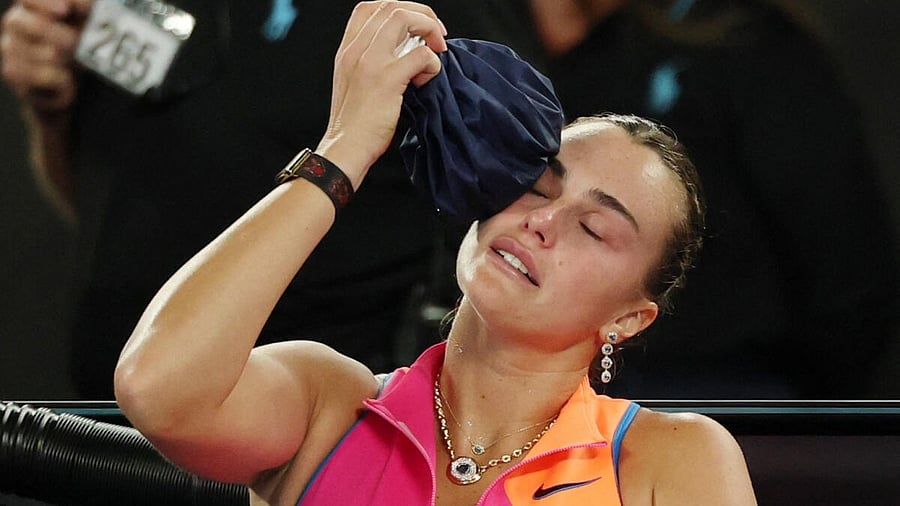
Belarus' Aryna Sabalenka
Credit: Reuters Photo
Bengaluru: One, two, three steps backward. She steadies herself. Two steps forward. Steady. Then she collapses backward… The harsh summer sun took its toll on a ball girl at the Australian Open in Melbourne, and it was there for everyone to see.
In Italy, the real life counterparts of Tina and Milo, the ermine and stoat mascots of the upcoming 2026 Winter Olympic Games, face existential threat in the Alps as their snow cover slowly melts away due to climate change. In fact, till last week, the hosts were contemplating importing tons of snow to hold the Games.
The two incidents occurred 16,000 kilometers apart, but are bound by a common issue of global warming that's negatively impacting every sphere of our life, and sport isn't exclusive to this churn.
At the beginning of the sporting calendar each year, especially after the devastating Australian bushfires and Covid-19 pandemic in 2020, the first tennis Grand Slam Downunder has become a reminder of the effects of a changing climate on the world of sport.
First to introduce the heat stress scale in 2019 under their extreme heat policy, instances of ball kids fainting, players cramping and nauseating, early starts to matches or contests being suspended – all due to rising temperatures – have become increasingly regular at the Aus Open.
The trend, now glaring more than ever before, is unsettling. And without wasting a minute, David Goldblatt, sports writer, football historian and climate activist, gets straight into the crux of the matter when questioned.
“We talk and worry about what will happen to the Australian Open because of global warming. But the biggest threat of all, I think, is for grassroots sport,” the 60-year-old Briton tells DHoS.
“Manchester United will be fine. However, the Football Association in England calculated that around 2,00,000 games were cancelled last year due to bad weather. That's a lot of grassroots football. The great waves have affected the USA, Japan or South Korea already, where we have seen abandonment of school sports. This could see less kids taking up sports. And that's a tragedy,” points Goldblatt.
Closer home, even the most religiously followed sport in the country has little mercy from the weather gods. According to several curators, it is becoming tougher to prepare well-groomed pitches due to unpredictable climate and one tiny blip in their calculations, dependent on the Indian Meteorological Department (IMD), could mean drastic change in the behaviour of the 22-yard strip directly affecting the outcome of a match.
The grim situation saw Sebastian Coe, president of World Athletics, remark that the ‘international calendar for Olympic sports may need to be re-engineered because of climate change’ following a rather ‘scorching’ World Athletics Championships in Tokyo in 2025.
The strikingly prominent casualty of all are winter sports. If the previous edition of the Winter Olympics in Beijing, China, relied on 100 per cent artificial snow for all outdoor events, this edition's hosts – Milano Cortina in Italy (slated from February 6 to 22) - were planning to use over 3 million cubic yards of machine-made snow due to declining natural snowfall. However, a delayed snowfall last week, has given the organisers some hope.
With the entire sporting ecosystem experiencing the repercussions of an uncontrollable variable, what are the consequences on an athlete’s body, mind and performance? A closer look at professional cyclists ahead of a Tour de France will tell you how training methods have been altered to combat spikes in temperature.
From active/ passive heat training to strategic dehydration/ cooling sessions, competitors undergo dedicated training programmes ahead of big races.
“Basically this is another piece of the puzzle. It would be kind of remiss of us to not be aware of how big a factor the impact of climate and temperature is,” begins Spencer Mackay, head of performance at JSW Sports, who has trained the likes of double Olympic medal-winning javelin thrower Neeraj Chopra.
“To break it down simply, we try and get someone's aerobic fitness up to be able to lower the heart rate so they can be more efficient or we try and develop someone's anaerobic fitness to be able to produce really high power output or energy when there's less oxygen available. "
“Then there is the acclimatisation and acclimation.. In terms of being at a venue well in advance of a competition to get used to the temperate conditions, time zone change, accommodation, food. This is the key. So players coming into the Aus Open would be aware of what they could face and would have prepared accordingly,” explains Irishman Mackay.
Right. That was one side of the story. But what about the other side of the coin? The part about sports’ growing carbon footprint on the environment.
Researchers have estimated that the sports industry is responsible for approximately 300-350 million tonnes of CO2e (Carbon Dioxide Equivalent) that's roughly 0.6 per cent to 1 per cent of total global emissions with FIFA World Cup and Olympic Games emitting 3-4 million tonnes of CO2e. While international travel is the main culprit, sports infrastructure and waste generated from big events are the other factors.
“Looking on the positive side of things, the Paris 2024 were probably the most environmentally sophisticated Olympic Games that were held with a real, serious and sustained effort to bring its giant carbon footprint under control. The Bundesliga (German football league), is another example. Teams have to demonstrate that they have an environmental policy that is active. Such critical criteria have to become the norm at global, national and regional levels,” says Goldblatt.
Speaking of which, this is where India, going through a booming sporting culture, becomes a driving force of green movement. But how? Climate11 Summit – Asia’s only conference on impact of climate change on sport – held last year in Delhi has led the way. Founded by Shamim Meraj, journalist and also the ex co-owner of Real Kashmir FC and co-founder of Ladakh FC, it was at the summit where a declaration on environmental sustainability in Indian sport was made.
“When a tiny little Ladakh FC in the mountains can pledge something this huge, why can't others?,” questions Goldblatt, who was part of the conference.
“First and foremost, the BCCI needs to sign up to the United Nation’s Sports for Climate Action framework where sports organisations commit to carbon neutrality by 2040 and halving their emissions by 2030. It's important that they don't merely join, but we actually hear India and the global south's voice in the conversations that are going on, because at the moment it’s only the Japanese talking to Danes talking to Canadians.
“Then, sporting events need to make use of India’s mind, start-ups who make cutlery out of wood, bamboo etc to replace single-use plastic. And finally, get star athletes to speak on the issue. I wish people listened to the poets, novelists and the climate scientists, but no one's listening to those guys. They are listening to (Sachin) Tendulkar. You know what I mean?,” says Goldblatt.
In sport, margins are measured in milliseconds and millimetres. Against climate change, there are no such luxuries. Hotter days, disappearing snow, cancelled matches and exhausted athletes are no longer rare disruptions; they are becoming routine. So, the question is no longer whether sport will be affected, but whether it will choose to respond. If it doesn’t, the games we love won’t just change, some of them may not survive at all.
At the Club World Cup held in the USA last year a cooling break at the end of each half of matches were given. Experts have warned about extreme heat risking health ahead of the FIFA World Cup to be jointly held in USA Mexico and Canada this summer.
Credit: X
Olympic rings in snow ahead of the Milano Cortina 2026 Winter Olympics in Cortina Italy January 30 2026.
Credit: Reuters Photo
At the first Grand Slam of the year -- the Australian Open -- the ‘heat stress’ rating hit highest level of five with 45 degree Celsius.
Studies suggest that 14 out of 16 stadiums during the FIFA World Cup in USA-Mexico-Canada later this will fall under ‘high-risk’ venues due to potentially dangerous levels of heat.
Retreating snowlines have forced the Winter Olympics organisers in Italy to rely on machine-made snow for skiing, snowboarding and ski jumping.
Temperatures crossed 30 degree Celsius with humidity above 90 per cent with marathons being the worst affected during the World Athletics Championships in Tokyo last year,