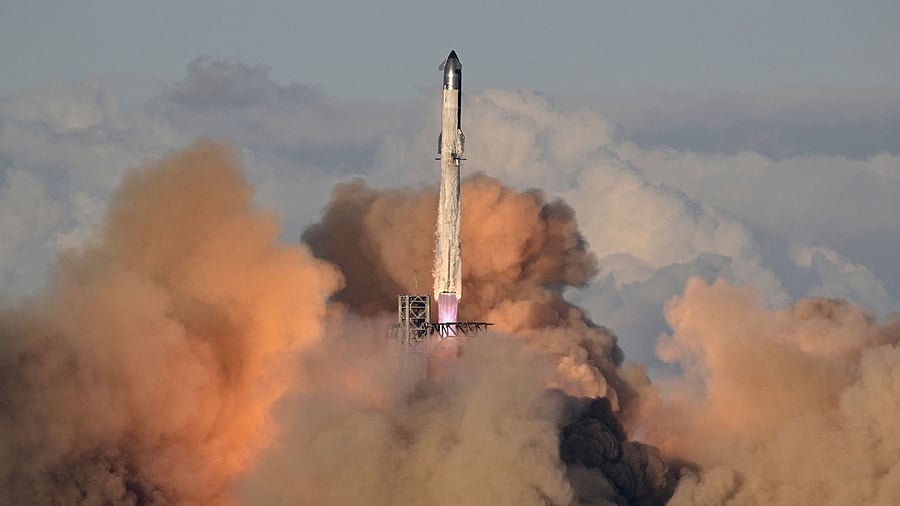
File photo for representational purpose.
Credit: Reuters photo
Washington: Investors eyeing SpaceX's potential blockbuster IPO may need to brace themselves as CEO Elon Musk balances his risky quest to reach Mars with growing the revenue-rich Starlink satellite broadband business that would offer more reliable shareholder returns.
SpaceX, which transformed space travel with reusable rockets and built a global satellite broadband network, is targeting a listing next year that could raise more than 25 billion dollars at a valuation exceeding 1 trillion dollars, which would rank among the largest initial public offerings in history.
Musk has always maintained that sending humans to Mars was his lifelong ambition. That should temper expectations that a publicly-listed SpaceX would narrow its focus on revenue-generating parts of the business like expanding Starlink into a direct-to-cell service or building space-based data centers, analysts say.
Investors in Musk's car company, Tesla, have also had to contend with balancing competing technologies and Musk's divided attention. The world's richest man has previously unsettled some investors by saying Tesla is not a car company but an artificial intelligence and robotics platform.
Investors have welcomed the SpaceX IPO. But Caleb Henry, analyst at space-focused research firm Quilty Analytics, said any buyer of SpaceX shares would need to accept that it has always invested billions of dollars in risky ventures, some of which, like Starlink and the Falcon 9 reusable rocket, have paid off after lengthy periods of experimentation.
"SpaceX has always been an R&D-heavy company and investors can sour if they feel they are not being rewarded for being investors. So, that can be hard," Henry said. "The investors of tomorrow will have to accept that."
SpaceX did not respond to a request for comment.
SpaceX IPO false dawns
There have been several false dawns for a SpaceX public listing, which has long been intertwined with Musk’s Mars obsession.
SpaceX President Gwynne Shotwell said in 2018 that the company would not go public until it was flying regularly to Mars, a goal that has been repeatedly delayed.
Musk, who on Wednesday hinted an IPO could be coming soon, has said SpaceX might launch an uncrewed Starship - its giant, next-generation rocket under development since around 2017 - to Mars next year. But analysts believe this is ambitious given the rocket has not yet completed a successful orbital mission.
Justus Parmar, CEO of Fortuna Investments, a venture capital firm invested in SpaceX, said he expected an IPO to happen after Starship has reached Mars, which would remove a huge risk factor for the business.
"He is taking a shot at sending this rocket to Mars… If that doesn’t work, that’s going to be very bad for the stock … (but as a) private (company), it’s not going to make a difference, there is no fluctuation in the stock,” Parmar said.
Abhi Tripathi, a former SpaceX director in the company's Dragon astronaut capsule unit, said rocket failures would likely be acceptable to investors, given they would "dwarf in comparison to the revenue generated by Starlink".
"So, will Wall Street even care about a few explosions that are somewhat insulated from the main revenue stream?" Tripathi said.
Beyond the risks tied to Mars ambitions, some analysts also question SpaceX's lofty valuation, which assumes meteoric growth from current annual revenue of 15 billion dollars, despite uncertainty over the market size for satellite-to-cell services and the feasibility of space-based data centers.
Proving doubters wrong
The strong prospects for Starlink and the belief among some tech executives that AI data centers will eventually be based in space may provide enough rationale to go public and a financial cushion for Starship testing failures, analysts say.
Starlink has been instrumental in funding the rapid and often setback-prone development of Starship. The rocket is designed not only to carry humans to the moon and Mars, but also to deploy larger Starlink satellites that will support the company’s potentially lucrative direct-to-cell Starlink Mobile service.
With roughly 10,000 satellites in space, Starlink has more than 6 million customers across at least 140 countries and territories. The company is nearing regulatory approval to operate in India, whose satellite broadband service market will be worth 1.9 billion dollars by 2030, according to Deloitte.
SpaceX last month filed to trademark Starlink Mobile, according to US government filings. The company on Tuesday said Starlink's direct-to-cell service is now active in Canada.
That business requires advances in satellite and communications receiver technology - which SpaceX plans for its next-generation Starlink satellites - to expand higher-bandwidth services such as global video-calling. The market could be worth 43.3 billion dollars by 2034, according to Allied Market Research.
Lucrative government programs such as US President Donald Trump's 150 billion dollars Golden Dome missile defense initiative could also expand SpaceX's national security satellite business, Starshield, and add future customers for the company's launch business.
A SpaceX IPO would help fund Musk's latest ambitious ploy: data centers in space. In theory, this could harness the power of the sun, leapfrogging Earth's energy bottlenecks and cementing SpaceX into the AI boom. But analysts warn cooling could be a challenge, launch costs must fall sharply and growing space debris adds a further complication.
Despite the laundry list of risks, market analysts believe many investors will ride out SpaceX's ups and downs, much as they have with Tesla.
"A lot of retail investors will probably get a lot of gray hairs from being a SpaceX investor," said Shay Boloor, chief market strategist for Futurum Equities Research.