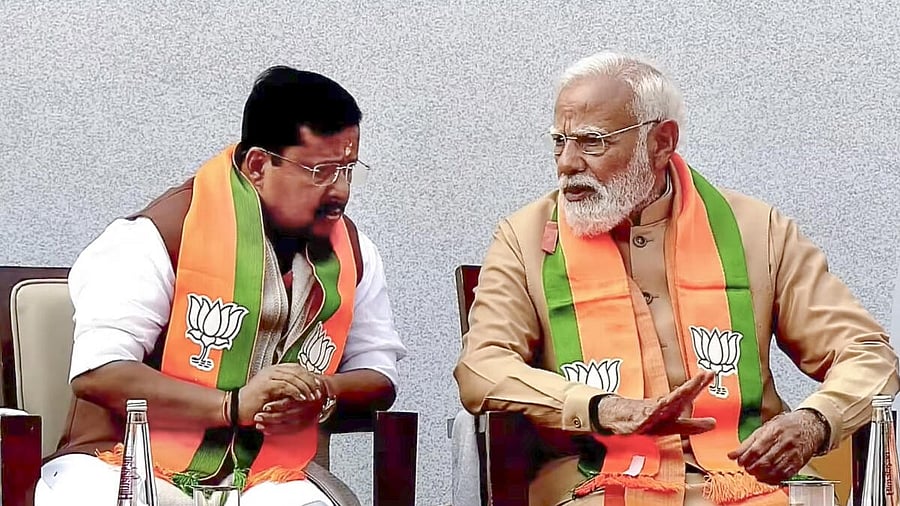
BJP National President Nitin Nabin and Prime Minister Narendra Modi.
Credit: @NarendraModi/YT via PTI Photo
In his January 20 speech at the politically choreographed function in the Bharatiya Janata Party (BJP) headquarters in New Delhi — where Nitin Nabin succeeded J P Nadda as the party's 12th president — Prime Minister Narendra Modi either forgot or was unaware of this William Shakespeare quote: “We cannot all be masters, nor all masters cannot be truly followed.” (Othello, Scene 1, Act 1). The bard’s words capture an enduring truth: not everyone is meant to lead.
Few would have believed Modi when he declared that he was merely an ordinary worker of the BJP and Nabin his boss. Not just because of his attributes, but also due to his temperament, Modi has little time for anyone who tries to match up to him even as an equal. From his school days, Modi saw none but himself as the ‘leader’, or in today’s politics, the ‘boss’.
The assertion was required, if only to ensure that when the new appointee speaks for Modi (or for the other half of the BJP’s power-duo, Union Home Minister Amit Shah), party leaders take him and his directives seriously.
That Modi felt compelled to make this point was little more than confirmation of a widely shared view within the political class: Nabin is, to date, the most diminished leader to occupy the chair of BJP president.
From that perspective, his biggest challenge will be to uphold the dignity of an office once held by stalwarts like Atal Bihari Vajpayee and Lal Krishna Advani. The problem, however, is that no previous president, other than Nadda, had to contend with the Modi-Shah duo overshadowing the presidential office. This alone makes Nabin’s task tougher — even insurmountable.
Nabin’s ‘selection’ came in mid-December with his appointment as the party’s working president, after protracted — though never publicly acknowledged — discord between Modi and the leadership of the BJP’s ideological fountainhead, the Rashtriya Swayamsevak Sangh (RSS).
With this startling appointment, Modi provided Mohan Bhagwat and his colleagues a face-saving device by picking someone from within the parivar, albeit a dynast, while at the same time also ensuring that Modi remained functionally autonomous in the larger scheme of things.
Unambiguously, Modi has conveyed the message that the party too, shall be managed as per his diktats and not by consultation with the Nagpur-based leadership.
In the run-up to the 2014 parliamentary polls, one of Modi’s glorified attributes was the creation of the ‘Gujarat Model’. People rooted for it without fully comprehending what this meant, and how it would play out in practice. On his own, when asked, Modi explained that he believed in ‘single-window style of functioning’. It was never stated that this window opened solely from inside the chief minister’s office.
The same model moved seamlessly to the Centre insofar as management of the Union government was concerned. It was also applicable for state governments run by the party and the BJP, especially after Shah’s term was over and Nadda moved into the position, first as working president in June 2019, and later as ‘regular’ president in January 2020.
There will be little change in the working relationship between the party organisation and the government (read: Modi). Nabin, like his predecessor, will likely receive ‘help’ from Shah, who will convey decisions to be taken, as well as the names of office-bearers and other party functionaries to be appointed.
Will Nabin then be little more than a custodian of a position without power? The answer lies in the public image of the party president during Nadda’s tenure. At no point was Nadda publicly belittled, nor did Modi or Shah make announcements or appointments that were the party president’s brief. After all, the party was theirs too, if not his alone.
But Nabin is not even on par with Nadda. He has, after all, been catapulted from a crowded political alley in Patna, where the BJP has grown in presence, influence, and clout in recent years.
Nabin’s appointment heralds a generational shift within the BJP. It is a paradox in the era of senior and veteran leaders, who play musical chairs while the captain remains seated. Many of those once speculated as Nadda’s replacement will now be pushed further to the margins, left beholden to whatever responsibilities are doled out to them.
These sidelined leaders, uncertain about the impact of Nabin’s rise on their own careers, may find hope in his statement at the ‘anointment’ ceremony. The new BJP president spoke of the BJP’s ‘watchtower’ as being extremely discerning — closely tracking leaders and workers at all levels, and elevating the meritorious to new positions.
The question, however, is whether these positions — sometimes offered to those least expecting them — will carry any real power. Given the party’s trajectory since 2014, it is only fair to await Nabin’s early run, before passing a verdict.
Nilanjan Mukhopadhyay is a journalist and author of ‘Narendra Modi: The Man, The Times’ and ‘The RSS: Icons of the Indian Right’. X: @NilanjanUdwin
(Disclaimer: The views expressed above are the author's own. They do not necessarily reflect the views of DH.)