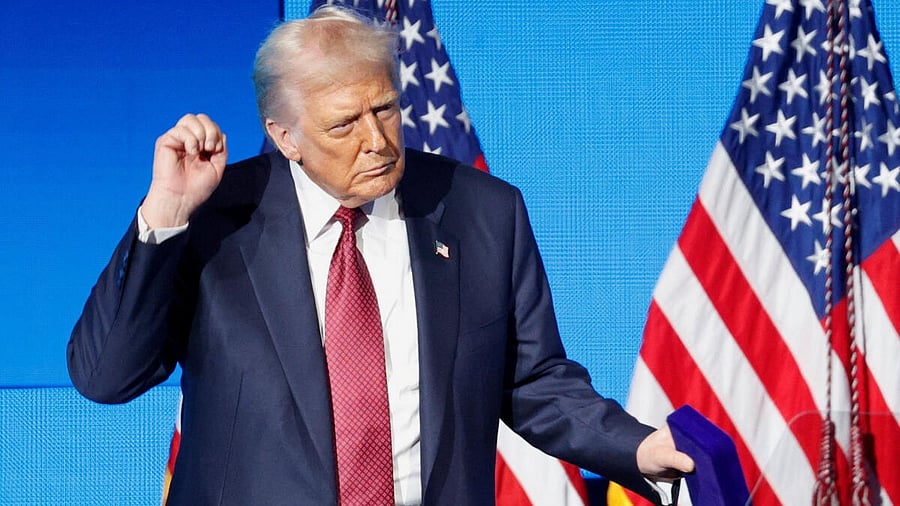
US President Donald Trump
Credit: Reuters Photo
It could have been a tightly shot Hollywood scene. The United States’ special operations officers on choppers land in the middle of the night at the enemy's hideout. They grab him, bundle him onto their chopper, then their ship, blindfolded and handcuffed. They use words like ‘capture’, and ‘extract’. They succeed.
But what unfolded on January 3 in Venezuela was no movie. And it had no heroes. Nicolas Maduro, the leader of Venezuela, had held on to power despite ample evidence that he had lost elections in 2024. The US soldiers who took him were sophisticated abductors, acting on the commands of a man who acts like a mafia don.
The Donald Trump administration's brazen and illegal abduction of Maduro is the clearest evidence yet that it intends to pursue 19th-century-style imperialism with 21st-century weapons and technology. The principles and institutions of international law, long hollowed out by the unilateralism of countries like the US, Russia, China, and Israel, have been ripped to shreds by this latest US aggression. If the leader of a sovereign nation can be dragged to another continent and jailed there, when he posed no real threat to the abductors, no president or prime minister, no country or territory is safe. Could Ayatollah Ali Khamenei of Iran be next? Or President Gustavo Petro of Colombia? Or President Miguel Diaz-Canel of Cuba?
And if presidents can be picked up in the middle of the night from sovereign nations, what about lesser mortals? There are several Indian citizens indicted in the US, on charges New Delhi does not necessarily agree with — from an intelligence agent accused of leading efforts to assassinate Sikh separatists to billionaire Gautam Adani. If Trump's justification for Maduro's abduction is that the Venezuelan leader faces charges in the US, Washington is essentially insisting that its law enforcement agencies have domain over the whole world, and don't need to even consult local authorities to do what they want.
By now, it is also abundantly clear that this wasn't about the narcotics that Trump claimed Maduro was sending to the US. As Trump and his seniormost advisers have bragged in recent days, the US wants Venezuelan oil. Its justification — that US companies helped develop Venezuela's oil industry before it was nationalised — is as absurd as it is baseless. International law is very clear: The principle of permanent sovereignty over natural resources says that sovereign nations have legal control over their natural resources, to use them as they desire.
If international law doesn't matter — and it clearly doesn't to Team Trump — then the US could tomorrow similarly claim resources in country after country.
After World War II, the US helped rebuild the infrastructure and manufacturing industries of Western Europe through the Marshall Plan. Perhaps it's time for the CIA to plan to take over the Volkswagen plant in Wolfsburg, Germany? In East Asia, Taiwan's now formidable chip manufacturing capability was built on the back of early technology transfer and aid from the US. Why wait to see if China chooses to invade Taiwan!
That the outlandish is no longer impossible, should give the world pause. It was important for India to express its "deep concerns" over the abduction of Maduro. But India's reluctance to call out the abduction for what it was — a blatant violation of international law and the rules-based order — was telling. China, Russia, Brazil and South Africa — India's original BRICS partners — were much harsher in their criticism of US actions, as were most African countries and several Latin American nations. Yet, if India thinks being cautious in its response will help it in its own troubled relationship with the Trump administration, it's mistaken. Europe's willingness to compromise with Trump on everything from tariffs to the war in Ukraine has not saved it from Washington's harsh criticism, or from the threat of the annexation of Greenland.
India must do more — using its decades of expertise as a bridge builder to try to get the world to near-unanimously push back firmly against Trump. The idea isn't to be confrontational, but to let the US president know that he can't pick off his targets one by one. Because that, it appears, is what he intends to do.
Decades of alliances and partnerships are meaningless, when making ‘America great again’ is tantamount to trampling over the rest of the world. Europe knows Greenland could be next. America's Arab allies know that he could turn on them too — after all, the US guarantees their security. And India knows that Trump's desperation to seal a trade pact with China means that he's willing to visit an authoritarian rival in April before a friendly democracy.
If Europe, India, and other major nations in the Global South come together to make clear — jointly — that abducting the president of a sovereign nation is unacceptable, it would send a broader message: that a return to the days of colonial conquests of lands and resources is unacceptable to most of the world.
That might also force the Trump administration to check its hubris over the fact that it got away with its Venezuelan crime without consequences.
Building such a consensus won't be easy. No country will take the risk of facing Trump's ire easily. But that is also why building a broad collective response is the way to go.
Trump believes that might is right. He needs to be called out: Might is often wrong.
Charu Sudan Kasturi is a senior journalist focusing on international relations, trade, energy, and technology.
Disclaimer: The views expressed above are the author's own. They do not necessarily reflect the views of DH.