
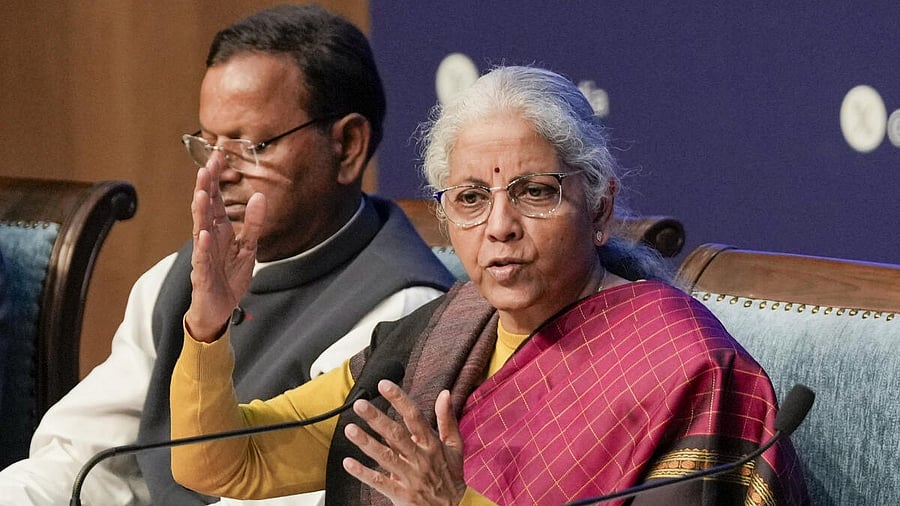
Finance Minister Nirmala Sitharaman, right, addresses a press conference after presenting the Union Budget 2026-27, in New Delhi, Sunday, Feb. 1, 2026. Minister of State for Finance Pankaj Chaudhary is also seen.
Credit: PTI Photo
Finance Minister Nirmala Sitharaman earlier today (February 1, 2026) presented the record ninth Union Budget. This year’s (2026-27 fiscal) Budget comes against the backdrop of intensifying global trade tensions, a record drop in the value of the rupee, a surge in gold and silver prices, and stock market volatility.
Due to large scale deployment of Artificial Intelligence (gen AI) technology, there is a surge in job losses worldwide. Domain experts opine that people who are ready to upskill themselves with gen AI tools, they are sure to get more opportunities.
Even the government has to play a critical role not just in upskilling students in emerging technologies such as AI, but also lay out incentives to attract companies to help set up more R&D, Global Capability Centres, and semiconductor electronics manufacturing in the country.
In the recently concluded Budget speech, the FM laid out a plan for the technology sector and education.
Union Budget 2026: Key takeaways for the technology sector
Tax holiday till 2047 for tech firms to set data centres in India: The FM announced that foreign companies providing global cloud services using Indian data centres will receive a tax holiday until 2047, provided they serve Indian customers through a local reseller.
Tweaks to tax laws on high-tech manufacturing tools: To promote the manufacturing of electronic goods for a contract manufacturer, the government has announced certain law changes to ensure that mere ownership of machines by a foreign company does not lead to income or taxes on it.
The rule change will apply until the 2030-31 tax year and only to factories set up in so-called customs-bonded areas, which are technically considered to be outside India’s customs border. If devices are sold within India from such factories, they will attract import taxes, making such facilities attractive only for exports. This will greatly help consumer electronics majors such as Apple, Samsung and others to scale up the local manufacturing of products in India.
India Semiconductor Mission 2.0: This initiative plans to build on the country’s semiconductor capabilities. ISM 2.0 will focus on equipment and material manufacturing and indigenous IP design. The government hopes to have industry-led R&D and training centres to create a skilled workforce.
Rs 40,000 crore outlay for electronics manufacturing: FM Nirmala Sitharaman doubled the outlay for electronics manufacturing from Rs 22,919 crore to Rs 40,000 crore. Also, FM announced that high-tech tool rooms will be established at two locations to give a push to capital goods manufacturing.
Unified IT Category: India is a global leader in software development services, IT-enabled services, knowledge process outsourcing services and contract R&D services. To keep the momentum going, the government has now clubbed Software development, IT-enabled services (ITES), KPO, and contract R&D into a single "Information Technology Services" category. This will reduce the Compliance and Intervention. And, approval for the safe harbour is now handled by an automated rule-driven process
The government has increased the threshold for availing safe harbour for IT services from Rs 300 crore to Rs 2,000 crore. This allows businesses to have long-term financial stability and predictability in their tax liabilities
Animation, Visual Effects, Gaming and Comics (AVGC) Sector: India’s Animation, Visual Effects, Gaming and Comics (AVGC) sector is a growing industry, which is projected to require 2 million professionals by 2030. So, FM has proposed to support the Indian Institute of Creative Technologies, Mumbai, in setting up AVGC Content Creator Labs in 15,000 secondary schools and 500 colleges across India.
AI in school curriculum: FM has proposed specific measures for embedding AI in the education curriculum from the school level and upgrading State Councils of Educational Research and Training institutes for teacher training.
AI in the Agriculture sector: FM has proposed to launch Bharat-VISTAAR—a multilingual AI tool that shall integrate the AgriStack portals and the ICAR package on agricultural practices with AI systems. The government believes this initiative will enhance farm productivity, enable better decisions for farmers and reduce risk by providing customised advisory support.
Get the latest news on new launches, gadget reviews, apps, cybersecurity, and more on personal technology only on DH Tech.