
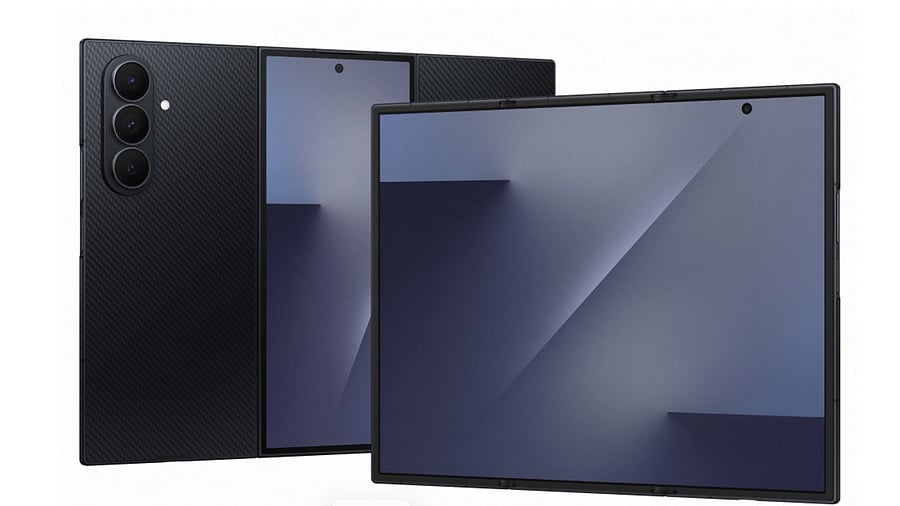
Samsung Galaxy Z TriFold.
Credit: Samsung
Technology companies Samsung, Lava International Ltd, Poco, Unix, and others launched smartphones, tablet, smart TV projectors, printers, camera accessories and more this week (December 8-14, 2025).
DH's Gadgets Weekly edition features the latest personal technology products and related events, keeping you informed about everything happening in consumer electronics.
Samsung Galaxy Z Trifold
Samsung Galaxu Z Trifold.
Credit: Samsung
The Galaxy Z Trifold, which was unveiled earlier this week, hit stores in South Korea. It is the first commercial variant of its kind from the house of Samsung.
The new generation foldable Samsung phone features an ultra-wide 10-inch bendable display, held by two cutting-edge hinges.
Samsung has incorporated two differently sized hinges with a dual-rail structure that work in harmony, creating a smoother, more stable fold despite varying weight and component distribution across the device. The hinge structure also allows the screen panels to meet securely with a minimal gap, enabling a thinner, more portable smartphone.
The hinges are made of high-quality titanium, and the frame features armoured aluminium. The device also comes with an IP48 rating.
Further, the company, as part of safety and quality measures, has made every unit undergo strict quality checks to achieve every small requirement. For instance, it has performed CT scanning of the flexible printed circuit board to verify that it has been correctly manufactured according to the design, ensuring accuracy and reliability before bonding it together with the other internal display components. Also, with laser scanning, the company has validated that all internal components are mounted precisely at their intended height and have secure surface quality.
As the 10-inch screen can fold twice, it can transition to a compact form factor and be able to put in a regular pant pocket. It also features a reinforced overcoat as a shock-absorbing display layer for better resistance across the dual-folding device.
It sports a 10.0-inch QXGA+ (2160 x 1584p) Dynamic AMOLED 2X with a pixel density of 269 ppi (pixels per inch) and supports 1,600 nits peak brightness and adaptive refresh rate (1~120 Hz).
Customers lined up buy Galaxy Z Trifold at Samsung store in Seoul.
Credit: Samsung
It also features a 6.5-inch FHD+ (2520x1080p) Dynamic AMOLED 2X screen with a pixel density of 422 ppi, support 21:9 aspect ratio, 2600 nits peak brightness and adaptive refresh rate (1~120 Hz).
Samsung's ultra-premium phone is powered by Qualcomm Snapdragon 8 Elite Gen 5 for Galaxy, Android 16-based OneUI 8 OS, 16GB RAM, 512GB/1TB storage, and a massive 5,600mAh battery with 45W wired charging speed capability and also supports 15W wireless charging as well.
Samsung Galaxy Z Trifold.
Credit: Samsung.
The new foldable phone features a 10 MP selfie camera (f/2.2, Pixel size: 1.12 μm, FOV: 85-degree field of view) on the cover display. Inside, it houses a 10MP Main Camera (f/2.2, Pixel size: 1.12 μm, FOV: 100-degree).
On the back, it boasts of a triple-camera module-- 12 MP Ultra-Wide Camera (with Dual Pixel AF, f/2.2, Pixel size: 1.4 μm, FOV: 120-degree), backed by 200 MP Wide-Angle Camera (with Quad Pixel AF, OIS, f/1.7, Pixel size: 0.6 μm, FOV: 85-degree, Optical Quality Zoom 2x) and 10 MP Telephoto Camera (with PDAF: Phase Detection Auto Focus, OIS: Optical Image Stabilisation, f/2.4, Pixel size: 1.0 μm, FOV: 36-degree, 3x Optical Zoom, Digital Zoom up to 30x) and a LED flash. It costs KRW 3,590,400 (approx. Rs 2,19,675).
Poco C85
Poco C85.
Credit: Poco India
Poco earlier this week launched the new budget Android C85 series phone.
It flaunts a 6.9-inch HD+ (1600 x 720p) with 120Hz refresh rate, offers up to 810 nits peak brightness (HBM), and comes with TÜV Rheinland Low Blue Light (Software Solution) and Flicker Free certifications.
It also features triple slots (two nano SIMs and a microSD card), a 3.5mm audio jack, FM Radio, a Type-C USB port and a side-mounted fingerprint sensor.
The device is powered by 6nm class MediaTek Dimensity 6300 octa-core processor, Arm Mali-G57 MC2 GPU, Android 15-based HyperOS 2.2, 4GB / 6GB / 8GB LPDDR4X RAM with 128GB UFS2.2 internal storage (expandable up to 1TB), dual-camera module with 50MP (f/1.8) main camera and secondary sensor with LED flash on the back, an 8MP (f/2.0) front camera and a 6,000mAh battery with 33W charger.
Poco C85 comes in three colours-- mystic purple, power black and spring green. It is available in three variants-- 4GB RAM + 128GB storage, 6GB RAM + 128GB storage and 8GB RAM + 128GB storage-- for Rs. 11,999, Rs 12,999 and Rs 14,499, respectively.
Lava Play Max
Lava Play Max.
Credit; Lava International Ltd.
Lava International Ltd earlier this week launched the new budget phone Play Max.
It sports a 6.72-inch full HD+ (1080 x 2400p) LCD screen, supports a 120Hz refresh rate, dual-SIM slots, side-mounted fingerprint sensor, microSD card slot and comes with an IP54 water-and-dust resistant rating.
Inside, the device houses 4nm class MediaTek Dimensity 7300 octa-core processor with Mali-G615 MC2 GPU, Android 15 OS, 6GB / 8GB LPDDR4X RAM, 128GB UFS 3.1 storage (expandable up to 1TB), main 50MP camera (with EIS, support up to 4K 30 fps video recording) with LED flash, a 8MP front camera, and a 5,000mAh battery with 33W fast charger.
It will be available in two colours-- Deccan Black and Himalayan White. It comes in two variants-- 6GB RAM + 128GB storage and 8GB RAM + 128GB storage-- for Rs 12,999 and Rs 14,499, respectively.
Adobe brings a dedicated tool to create YouTube Shorts
Adobe Priemere gets dedicated tool for YouTube Shorts.
Credit: Adobe
Adobe, earlier this week, launched new tools for creators to create YouTube Shorts.
Users get access to Adobe’s powerful video editing tools, including exclusive effects, transitions, templates, presets and more designed for creating eye-catching YouTube Shorts.
With the tools, users can explore and customise ready-to-use templates with stand-out transitions and effects for polished content.
Users can also reuse their own original templates to create more unique effects and start their own new YouTube trend. Once finished, users can instantly upload videos to YouTube Shorts in just a few taps.
LG brings new washing machines with AI DD 2.0 tech
LG's new washing machines with AI DD 2.0 tech.
Credit: LG India
The new range includes 10 models ranging from washer-dryers, front load washing machines to top load washing machines equipped with advanced AI for superior fabric care, intelligent washing, and enhanced convenience.
The new LG front-loading washing machine boasts of Powered by AI DD 2.0 technology. It can detect fabric weight, type, and soil level to automatically choose the most suitable wash cycle for optimal fabric protection and care. The Steam+ technology further enhances washing performance by reducing wrinkles and eliminating allergens, keeping clothes fresh, hygienic and smooth.
The TurboWash 360 feature, with its multi-directional water jets, thoroughly cleans clothes in just 39 minutes without compromising on quality. The eZDispense provides seamless auto-dosing for nearly 30 washes, which reduces the work for the owner.
It also comes with LG ThinQ smart connectivity, which allows users to remotely control and monitor the machine, adding convenience to daily laundry management.
The AIDD 2.0 Series also includes thoughtful programs such as Allergy Care and Baby Steam Care, designed to cater to delicate fabrics and sensitive skin.
Additionally, the Microplastic Care cycle helps reduce microplastic emissions by up to 60 per cent. The new range of front-load washing machines comes with minimalist design features, Digital Dial LCD, which adds an elegant modern touch while offering smoother, more intuitive control for everyday use. The range with Flat tempered glass door with a chrome finish comes in premium colours, making them a stylish addition to modern homes. Designed for energy and water efficiency, the new models combine performance, care and aesthetics in one sophisticated package.
The top-loading washing machine also comes with AI DD technology, which can intelligently detect the weight and type of fabrics and automatically select the optimal wash pattern from 20,000 possible combinations, ensuring effective cleaning with gentle care. The TurboWash feature enables a full load to be washed in just 29 minutes, offering both speed and efficiency for busy households.
To ensure hygiene, the Steam with In-Built Heater eliminates up to 99.9 per cent of allergens, providing cleaner and safer laundry. It also supports the LG ThinQ Wi-Fi connectivity for remote operation. The machine also features a water-resistant IPX4-rated control panel for durability and a premium Jog Dial design on the rear panel that enhances usability and aesthetics.
The special modes like Stain Clean, which is harsh on stains, and Duvet Mode ensure bulky bedding is washed thoroughly. It is available in a large 11 kg drum and a sleek flat design to balance the performance, design, and practicality.
The front-load range is priced between Rs 69,990 and Rs 1,39,990, while the top-load range is priced between Rs 38,990 and Rs 46,990.
Unix Epic headphones
Unix Epic headphones.
Credit: Unix
The headset flaunts graffiti-inspired RGB design and comes equipped with 40mm drivers tuned for clarity and impact, supporting Hi-Res audio for richer detail and a more immersive listening experience.
Users can enjoy clearer vocals, deeper bass, and well-defined instrument separation, making music sound fuller and more lifelike.
With the frequency response of 20Hz to 20kHz, 32Ω impedance, and 120dB/V ± 3dB sensitivity, the headphones ensure compatibility with most companion devices and strong, consistent output across genres, from bass-heavy tracks to acoustic or vocal-led music.
It houses a 400mAh polymer lithium battery and delivers up to 62 hours of continuous listening on a single charge. On Standby mode, it can last for 450 hours. It costs Rs 1,499 on Flipkart.
DailyObjects Playground Store launched in Mumbai
DailyObjects store at Jio World Drive, Mumbai.
Credit: DailyObjects
India's leading accessory-maker, DailyObject, earlier this week launched the Playground store at Jio World Drive, Bandra Kurla Complex, Mumbai.
The new store is in a unique elliptical, open-loop form with thoughtfully placed glass partitions that allow customers to experience DailyObjects' accessories.
“At DailyObjects, design is not just what you see; it’s an experience. The Playground, our signature experiential space format, brings that to life, offering an immersive environment where visitors engage with our products, forging a deeper, multi-sensory connection and lasting affinity with the brand,” said Pankaj Garg, founder, DailyObjects.
Samsung unveils new Samsung’s new vision document, as it marks 30th anniversary
JB Park, President & CEO, Samsung Southwest Asia.
Credit: Samsung India
Samsung forayed into the Indian market, and since then, it has grown to become one of the biggest brands in the country.
It now sells several categories of consumer electronics, ranging from smartphones, tablets, smart wearables, washing machines, air conditioners, smart TVs and more. In recent years, it has introduced several Artificial Intelligence-powered Internet-of-Things, even home appliances, with the SmartThings ecosystem.
Now, it generates more than 1.11 lakh crore annual revenue. As it marks the 30th anniversary, Samsung has announced a new vision document.
The company already has more than 14,000 patents, and it has announced plans to expand the R&D ecosystem for advancements in technologies such as AI, accessibility, streaming, and digital displays, along with next-generation networks.
“From selling our first TV in India in 1995, when liberalisation was unlocking new possibilities to becoming the most trusted technology partner for Bharat today, Samsung’s journey has been shaped by India’s confidence, creativity, and limitless ambition. As the most loved and widely adopted brand inside Indian homes — through our smartphones, TVs, digital appliances, and a seamlessly-connected ecosystem — we are proud to make lives better every day for millions of Indian families. Young Indians expect technology to be secure, intuitive, and always evolving, and we are committed to delivering personalised innovations for them. We believe the next era of meaningful global innovation will be led by India, where the future of smart homes, connected living, and intelligent devices is rapidly taking shape with AI that understands India’s cultural diversity. We will continue to work closely with the Government of India for a Viksit Bharat, creating a digitally empowered nation where innovation fuels inclusive progress and co-prosperity. Our vision is clear: to build advanced technologies here that will shape how the world lives, works, and connects tomorrow,” said JB Park, President & CEO, Samsung Southwest Asia.
It also announced to expand Corporate Social Responsibility (CSR) initiatives, including Samsung Solve for Tomorrow, Samsung Innovation Campus, and Samsung DOST, to nurture India’s next-generation workforce, aligned with the requirements of Industry 4.0.
Samsung promises to provide access to grants, incubation support, skills in AI, IoT, digital technologies, and employment opportunities to Indian students.
Haier Gravity AI Series AC
Haier Gravity AI Series AC.
Credit: Haier
It is touted to be the industry's first AC in India to offer Auto Clean Outdoor Technology that requires zero manual efforts.
It boasts of a powerful reverse-airflow that keeps the outdoor unit clean, ensuring faster cooling, lower energy use, and year-round reliable performance.
The indoor unit also cleans itself automatically every 240 hours using an AI Frost Self-Clean process, making the Gravity AI Series the most advanced and future-ready AC line-up from Haier to date.
It also comes with AI Target Cooling for precision-directed airflow and AI Pre-Cooling with a 100-meter geofence that anticipates user arrival to cool the room in advance for instant comfort. For energy efficiency, it features multi-level AI ECO optimises energy usage in real time, ensuring peak efficiency without compromising performance.
Haier Gravity AI Series ACs will be available in 4 models-- 1) HSU19G-MZAIM5BN-INV in Morning Mis; 2) HSU19G-MZAIS5BN-INV in Moonstone Grey; 3) HSU19G-MZAID5BN-INV in Midnight Dream; 4) HSU19G-MZAIW5BN-INV in White-- with prices starting at Rs 49,990.
Vivo releases annual Switch Off Report 2025
Vivo Switch Off report 2025.
Credit: Vivo India
In the latest annual Switch Off Report titled ‘The Impact of Excessive Smartphone Usage on Parent-Child Relationships’, Vivo has come up with very important insights on the interaction of parents and children at home.
One of the most striking insights from this year’s study is the rapid rise of the use of Artificial Intelligence in children’s daily lives.
Driven by curiosity, creativity and evolving academic needs, 54% of children aged 10–16 now turn to AI tools regularly — whether for homework and assignments (61%), personal growth (63%), or even companionship. In fact, 1 in 3 children say they sometimes view AI as a substitute for real-life connection, and 1 in 4 feel they speak to their parents less because they believe their parents are too busy.
On the bright side, most families consciously control the usage of smartphones during dinner.
According to the report, 72 per cent of children say they spend the most quality time with parents during phone-free moments, and 91 per cent feel conversations become easier and more meaningful when devices are out of sight. This naturally places dinner time at the centre of connection — a daily touchpoint where attention aligns, stories flow, and genuine bonding returns.
Get the latest news on new launches, gadget reviews, apps, cybersecurity, and more on personal technology only on DH Tech.